
Comparaduns are one of the most versatile mayfly patterns in existence representing a low-riding mayfly to near perfection. However, many tiers shy this simple pattern due to the perceived complexity of tying the deer hair wings
Comparaduns are one of the most versatile mayfly patterns in existence representing a low-riding mayfly to near perfection. They are commonly used during a PMD (pale morning dun) hatch. However, many folks deny themselves of tying this simple pattern due to the perceived complexity of tying the deer hair wings. With the steps and tips below, GFF makes the tying comparaduns comparaDONE!
A trailing shuck comparadun is the pattern at-hand, commonly called the Sparkle Dun. The traditional call for materials in a comparadun is to use a tailing material such as a few hackle fibers or micro-fibettes. However, using a dozen-or-so fibers of antron makes this pattern much more versatile as we explore further in this text. Let's start!...
The Bill of Materials (& a word on deer hair selection)
Need more help in selecting deer hair?
Read this article on stacking and selecting material by Wayne Luallen or Read this article on selecting deer hair by Chris Helm.

Comparadun materials are few and simple. Summer deer hair, tailing material (antron, in this case) and superfine dubbing material.

Selecting the proper deer hair for use in a comparadun is critical to making the fly easy to tie. Choose summer deer hair, hair that is thin and less straw-like. The dark hair on the left has thinner hair fibers than the light hair on the right. The thicker the hair fibers, the harder it will be to manage the wing tying steps.

A thread bump above the hook barb helps lift the tailing fibers.

Secure the antron on the hookshank from the thread bump to the middle of the shank.
Step 1.
One secret to making the comparadun ride flush in the surface film is to raise the tail just slightly from the plane of the hook shank. Do this by building up a slight thread bump at the tail above the hook barb. It helps to flatten the thread slightly by twirling the bobbin counter-clockwise to undo the natural twist in tying thread.
Read more about thread control in this article by GFF Partner Martin Joergensen.

Trim at both ends and continue the thread forward to the 2/3rds point (not shown here).
Step 2.
Tying the antron tailing material is easy. No pain here. Tie the antron on the hook shank just above the thread bump to make the tail rise just a tad. Trim the tail to equal the length of the hook shank.

Be sure to stack the deer hair tips evenly.

Measure the deer hair tips to equal the hook shank length.

Secure the deer hair on the shank with 5-6 tight thread wraps. Hold onto the stub-ends at all times. Don't worry about the hair flaring all around the shank; we will fix that in a moment!

Trim the deer hair at an angle to form an angled transistion from the deer hair to the tail. (see the picture below)

Prepare the hookshank for dubbing by wrapping thread to create a gradual transistion from the deerhair to the tail.
Step 3.
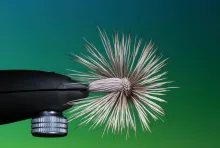
Select a fair amount of deer hair, looking for an amount, which when splayed, will cover a 180-degree arc around the top-half of the hookshank. Study and follow closely the photographs to get a perfect comparadun-style splay with the deer hair.
Read more deerhair stacking secrets by Wayne Luallen.

Here's the secret of tying a comparadun!
wrap 2 turns of dubbing OVER the base of the deer hair, compressing them in a nifty little bunch.

Now, pull the deer hair back and continue wrapping the dubbing TIGHTLY in front of the deer hair base. You have mastered the secret to making comparaduns!
Step 4.
Dubbing the body is no trick at all!...but there is one trick to making comparaduns look the way they do! Read the captions below the pictures in Step 4 to find the secret!
When dubbing, remember to use fine dubbing and keep the dubbing thin at the tail. Use a bit more dubbing as you move forward on the hookshank. I prefer rabbit underfur, muskrat or mink dubbing due to the finess of the material. If you use rabbit (such as in the pictures to the right), pre-treat the body with a drop of dry fly floatant since rabbit fur has a tendancy to absorb water more readily.
Read more on dry fly dubbing and waterproofing.

After tying off using a whip-finish or half-hitch, use your fingers, work the deer backwards and around the top-half of the hookshank until you are satisfied with the splayed shape.
Step 5.
Tie off and work the deerhair as mentioned in the picture captions.
Need help with tying off? Read how to tie a whip-finish here.

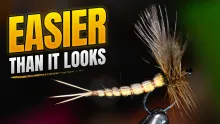
A finished Trailing Shuck Comparadun or commonly called a Sparkle Dun.

Looking at the Sparkle Dun from behind shows the elevated tail, the tapered body and the 180-degree arc of the deer hair; all are characteristic traits of a comparadun-style fly.
Final Thoughts...
A finished Trailing Shuck Comparadun is one versatile mayfly pattern!
With some ingenuity on-stream, this pattern can be modified in a variety of ways to fool picky trout. Use these following tricks to make-do on the stream...
Need a classic dry fly, not a low-riding emerger?
Trim off a few tail fibers to represent a mature adult!
The trout aren't taking the mayflies in the film?
Rub the fly in some sink goop or mud and fish the fly as an emergent mayfly!
You have no caddis emergers in your box?
Trim off some of the deer hair from the sides and push the top hairs back. Swing it as a caddis emerger!
- Log in to post comments


You are generally welcome
Peter,
You are generally welcome to use our material in instruction sheets and club newsletters etc. as long as it's non-profit, which I guess your tying club is.
Martin
Will you grant me permission
Great Pattern,
I am compiling a set of instructions for our fly tying club which consists of about 20 members.
The idea is we illustrate a pattern, a demonstrator does it at the meeting, then we all tie the pattern with any help from the experienced members.
Will you grant me permission to copy the diagrams and instructions please? Not for profit, illustrations only distributed to the club and not for publication outside the group. Thanks in anticipation. Please do not publish this request as this is a one off request. Reply to e-mail please
Elk hair
Could you use elk hair?
Ditto to Clint's post
Ditto to Clint's post. Your method makes it a breeze to tie.
Most effective and practical way
I have tied flies for many years and I have tied this style many ways. Your method is the most effective and practical way to construct a comparadun. Strong and duriable, they work and they last.
Fairly large for a dry fly
Ronald,
Steve didn't mention hooks size, but it seems fairly large for a dry fly, and my guess is that the hook shown is a size 10 or 12. You can of course tie Comparaduns smaller - depending on your dexterity and skill.
Martin
What # hook
what # hook did you use to make this Compara dun i just started making my own flies ,so anything you could share or tell me it would help Thanks Ronald
Zelon for the trailing shuck
I don't think you want to use antron for the shuck. Antron mats when it gets wet. The Craig Mathews invented Sparkle Dun Comparadun calls for using zelon for the trailing shuck.
Such a great fly
the comparadun is such a great fly. its one of my favorite dries. great for the pale morning dun and also in olive for the bwo. its just an all around great fly that i have been afraid to tackle because of the deer hair wing. but now im set!
Well done
Well done, thanks a bunch. My wife has been diagnosed with a nasty lung disease that is caused by bird dust. Her lungs are clearing with medication but our pet parrot and all my fly tying feathers are off to new homes. This will keep me in the game without worries. Don't toss out your favorite hackles chances of them causing a problem on a healthy individual are about zero.
Going in to tie
Going in to tie the COMPARADUN before I lose mental image of it, thank's for providing a great website.
Very nice description
Very nice description of how to tie this classic dry fly. Once you master the simple techniques described, you will love tying this pattern. I tie more of these than almost any other dry fly pattern.
hmmmm solved my prob
hmmmm solved my problem with tying them. I was tying the deer hair the oposite direction. Big help.
Thanks
Jamie
Excellent article
Excellent article, and an excellent step-by-step.
Great for guys like me who don't tie too many dry flies!
Thank You so Much!!
Thank You so Much!! I had to finish this fly for a class, and I wasn't sure how to do it, but this showed me with such precision I was able to tie the best one. Thanks again.
I use these by the dozens
I use these by the dozens on selective trout on the Missouri on 6-7x tippets, so I lose a lot of them. But this is an easy, quick, and effective way to tie the comparadun.
Comparadun or Sparkle Dun
Wouldn't this variation using the Antron tail be a Sparkle Dun rather than a Comparadun?
Yes
Brady,
That's absolutely right, and it also says in the article in one of the captions: "A finished Trailing Shuck Comparadun or commonly called a Sparkle Dun.", so you are quite right.
Martin