
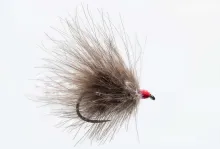
Hans Weilenmann's classical contemporary sedge fly.

CDC&Elk is One of the contemporary classics. The originator, Hans Weilenmann, tells the story of the fly.
Montana
My first trip to Montana took place in July/August 1982. In preparation for this trip I read up on all the hatch-charts and other information I could lay my hands on. I then compiled all the required patterns and commenced tying them. (I was naive and more gullible then...) I literally tied up hundreds of flies.
Caddis all the way
Dries, wets, nymphs and emergers in sizes ranging from #10 4XL through to #28. Unfortunately, very few of the anticipated hatches actually materialized. Apart from one rather spectacular Yellow Sally egg-laying session on Rock Creek, where an imitation (with a deer hair bullet-head, extended body made from twisted
yellow poly yarn and a trimmed grizzly hackle wing tied flat) triggered explosive rises, it was caddis all the way. Not a mayfly in sight. So I fished the Elk Hair Caddis. And the EHC.
EHC
When this fly did not work, I'd fish the EHC. I'm sure you get the picture. Anyway, to cut a long story short, the EHC has been one of my most effective dry fly patterns from this time onward. Mostly I would follow the Troth pattern closely: dubbed body, palmered hackle, counter-ribbed with fine gold wire. Or, on #16 and smaller, sometimes only dubbing without hackle.
The Troth path
The last season, though, I deviated from the Troth path. With the increased availability of CDC in natural and dyed colors I started experimenting with this material on my core set of fishing flies. For my EHC I started using CDC barbules dubbed onto the thread. Although this worked OK, it did not really improve on the pattern. What I wanted to achieve, next to (perhaps) improved floatation, was a stronger illusion of movement, i.e. to utilize the in-built mobility of the CDC feather. I tried and discarded to trap the CDC barbules in a dubbing loop. Tying in clumps of CDC barbules was not satisfactory, either. Various other options were tried and rejected. The answer turned out to be to use the whole CDC feather, including stem. The resulting fly, basically a modified EHC, I call the CDC&Elk.
Materials:
| Hook | Rather large (up to #12) dry fly. Debarbed. |
| Thread | Brown or tan |
| Body | Cul de Canard (CDC) feather, natural or dyed |
| Wing | Fine-tipped deer hair |
Tying instructions:
- Attach the thread halfway down the hookshank and run backwards to the bend.
- Select a CDC feather of the required color and size. (The longest barbule approx. 2 times shank-length) Hold the CDC feather at the butt and, by stroking the feather between thumb and index finger towards the tip, bunch the tips together.
- Tie in the bunch, butt pointing backwards. Tie down with two turns, then slip a third turn under the tips and a fourth turn over the barbules, just forward of the third. This will lock the CDC barbules in place and prevent them from coming loose. Spiral thread forward to eye, then back one turn.
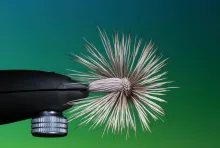
- Clamp butt with hackle pliers and wind the CDC feather towards the eye in touching turns. You will find that the rear half of the body will resemble a dubbed one, but as you progress towards the eye, more and more free barbules appear. Stroke these backwards with each turn. A little practice will enable you to arrive at the eye with only the bare part of the stem left.
- Tie off with one tight turn of thread, unclip the hackle but do not trim yet. Tighten with a second and third turn of thread. You will see that the CDC butt will move with the thread, securing the tie-off point. Clip the CDC butt.
- Finish off as a regular EHC. I like to trim the deer-hair to the required length before tying it in. Your mileage may vary.
To summarize: the EHC is a great fly, but I like to think the CDC&Elk improves on this great pattern. If possible, better floating. Surprisingly durable. Illusion of movement provided by the straggling CDC barbules to suggest legs, antenna, trailing shuck, crippled wings, etc. Easily obtainable materials and incredibly easy and fast to tie. And it even catches fish!
Do give it a try...
Hans Weilenmann
© 1996 Hans Weilenmann
Hand picked for this article


- Log in to post comments



If you want to attac
If you want to attach your name to a 'new' combination of materials and/or techniques - fill yer boots.
Hans Weilenmen, and others, have built a reputation for contributing and sharing, not one that brings to mind an attitude of self aggrandisement.
When I sit down to the vise I'm calling up 30+ years of experience and exposure to a myriad of fly tiers. Though I recognize all that influence, it doesn't stop me from feeling I've created something unique. Some people have even referred to my creations as 'my' flies. 'Dave' is such a common name, even I couldn't say it's mine.
This is a truly rema
This is a truly remarkable pattern, economical in every way. The trailing CDC fibres are what really trigger.
My only problem with this is when I tie this in smaller sizes - 16 to 20 - esp. 16, the fly seems to want to roll over on an angle almost to its side. Any ideas?
I think the CDC&Elk
I think the CDC&Elk as described above is a very efficient and innovative solution.The beauty of this tying techniqe is that you avoid a dubbing rope all together and you don't need to invest in any special tools for dealing with the CDC feather. There is a nice description on the classification and selection of CDC feathers that I believe H. Weilenmann authored. This has helped me immensely. There is even a very straight-forward video of the technique available on the internet.
This is a relatively simple fly to tie. I have tied the fly with a light yellow CDC feather and elk hair dyed a soft green. It has worked extremely well for me and I have incorporated the pattern into my Top 10 of "must-have" flies.
Chuck,
I'm sure H
Chuck,
I'm sure Hans would never claim to have originated the EHC - and he certainly doesn't do so here. He even mentions Al Troth - the true originator - in the article.
Regarding the CDC "rope" as a body, it might very well be that Marc Petitjean has a similar technique in some of his patterns, but roping a feather can hardly be called an original way of doing things anyway. Claiming to originate that would be like claiming the fame of having invented hackling or dubbing... You may stumble upon the idea without prior knowledge, but many tiers have done that and used the technique before you.
What Hans did - and is the truly originator of - was to combine the two - Al Troth's Elk Hair Caddis and whoever's CDC roping technique - into a very versatile, easily tied and effective fly.
Martin
I thought Petitjean
I thought Petitjean originated the use of CDC in roping the body for a CDC caddis ;-).... and i don't recall Hans Weilenmann's name in association with the origination of the ElkHair Caddis....i could be mistaken though. So if i were to take a classic Catskill Dry fly like say, The adams and use CDC puffs for wings --- could i then claim to be it's originator?