The Charlie Fly - Fur from the originator's Chocolate Lab inspired this sea trout producer - Global FlyFisher

GFF logo


The Charlie Fly


Published Mar 30th 2009

Fur from the originator's Chocolate Lab inspired this sea trout producer

By Martin Joergensen, Ken Bonde Larsen

The Charlie Fly
Martin Joergensen

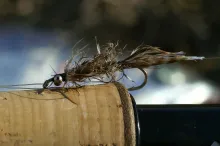
A Chocolate Labrador has not only delivered the name for this fly, but also one of its main materials - the body dubbing.
Charlie is the originator Ken Bonde Larsen's 12 year old brown lab, and since his first year his underfur (the dog's that is) has been meticulously saved by Ken as a staple material for fly tying. This particular batch has been mixed with some copper/brown Angle Hair to add a bit of sparkle, but has still kept the brownish, grayish tone, which is typical for most dark dog underfur. You can of course replace the dog underfur with the underfur of the brown Arctic fox used for the tail - should you not have a Chocolate Lab in the house.

This particular pattern has by far been his most productive Charlie-underfur-pattern, and is now a permanent resident in Ken's coastal fly box.

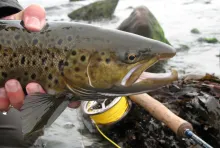
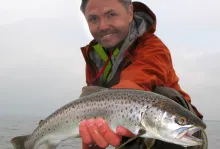
He uses it as a go-to-pattern on days with clear water and calm conditions or when the fish seem to be in the mood for "small and discrete". The fly isn't minute, but its colors and size aren't exactly yelling out "here I come!" either. Ken's entries in our small online report system tells the story. He has registered about 40 sea trout caught on this fly during the last few years.
The fly is again one of those generic patterns, which don't imitate anything in particular, and it would most likely produce both bonefish, brown trout, bass and panfish if used for these species.

Charlies
Ken Bonde Larsen - Birgitte Claussen


As you might remember, we have featured "dog patterns" on GFF before, and can remind you of The Mia Fly (Cocker Spaniel) and the Sunray Shadow (Shetland Sheepdog), and we know that angler's dogs have delivered hair and fur for many a killer fly.

The Charlie Fly
TypeCold saltwater fly
Originator
Ken Bonde Larsen
Year of origin
2004
Difficulty
Easy
Target species
Sea trout (sea run)

Materials
HookShort shank wet fly, #4-8
Tying threadBurnt orange
TagWarm pearlescent flash
TailBrown Arctic fox
RibCopper wire
BodyChocolate Lab underfur mixed with copper Angel Hair
HackleBrown rooster
HeadTying thread

Tying instructions
See the tying instructions below


+
Step 1 - the hook - Use a short shank, heavy hookyyy
 Step 1 - the hook 
Martin Joergensen
+
Step 2 - weight - Add a bit of weight on the front part of the hook shankyyy
 Step 2 - weight 
Martin Joergensen
+
Step 3 - start the thread - Cover the weight and the hook shank with threadyyy
 Step 3 - start the thread 
Martin Joergensen
+
Step 4 - flash - Tie in a bit of flash in the rear of the hook shankyyy
 Step 4 - flash 
Martin Joergensen
+
Step 5 - varnish - Varnish the hook shank with nail polishyyy
 Step 5 - varnish 
Martin Joergensen
+
Step 6 - tag - Wind the flash over the still wet nail polish to form a fairly long tag - 1/3 of the hook shank in lenghtyyy
 Step 6 - tag 
Martin Joergensen
+
Step 7 - finish tag - Secure the flash with the tying thread and trim the remainsyyy
 Step 7 - finish tag 
Martin Joergensen
+
Step 8 - tail - Tie in the tail in front of the tag. Notice how the butts are tied down along whole hook shank to form an even body.yyy
 Step 8 - tail 
Martin Joergensen
+
Step 9 - finish tail - Cover the butts with an even layer of thread and wind the thread to the rear of the shank. Trim the butts if they protrude over the hook eye.yyy
 Step 9 - finish tail 
Martin Joergensen
+
Step 10 - twinkle - Tie in a couple of straws of twinkle flash centrally on one side of the tailyyy
 Step 10 - twinkle 
Martin Joergensen
+
Step 11 - flash in tail - Pull back the twinkle on the opposite side of the tail and tie down so that two straws stick out on each side of the tailyyy
 Step 11 - flash in tail 
Martin Joergensen
+
Step 12 - trim flash - Trim the twinkle to the same length as the longest hair in the tailyyy
 Step 12 - trim flash 
Martin Joergensen
+
Step 13 - rib - Tie in copper wire as a rib to the rear of the bodyyyy
 Step 13 - rib 
Martin Joergensen
+
Step 14 - dub thread - Apply dubbing sparsely to the tying threadyyy
 Step 14 - dub thread 
Martin Joergensen
+
Step 15 - body - Form the body with the dubbing. It should end up nicely cylindricalyyy
 Step 15 - body 
Martin Joergensen
+
Step 16 - dubbing done - Stop the dubbing just short of the hook eye, leaving space for the hackle and a small headyyy
 Step 16 - dubbing done 
Martin Joergensen
+
Step 17 - tease - Tease out the dubbing with a Velcro stickyyy
 Step 17 - tease 
Martin Joergensen
+
Step 18 - fluffy - The final look can be quite fluffy - the rib and hackle will mash the hair partly down againyyy
 Step 18 - fluffy 
Martin Joergensen
+
Step 19 - prepare hackle - Trim the stem on the hackleyyy
 Step 19 - prepare hackle 
Martin Joergensen
+
Step 20 - tie in hackle - Tie in the hackle, shiny side out and sticking backwards on the flyyyy
 Step 20 - tie in hackle 
Martin Joergensen
+
Step 21 - start hackle - Take a full turn of hackle in front of the body before continuing to the rear in 4-5 open turnsyyy
 Step 21 - start hackle 
Martin Joergensen
+
Step 22 - catch hackle - Catch the hackle with the rib and secure the feather with 4-5 turns of ribbing towards the front of the fly. If you wiggle the rib, you don\'t trap any feather fibers.yyy
 Step 22 - catch hackle 
Martin Joergensen
+
Step 23 - tie down rib - Tie down the rib in the front of the body. Trim the copper wire and the hackle tipyyy
 Step 23 - tie down rib 
Martin Joergensen
+
Step 24 - head - Form a small head over the hackle butt and the copper wireyyy
 Step 24 - head 
Martin Joergensen
+
Step 25 - whip finish - Whip finish a couple of times over the headyyy
 Step 25 - whip finish 
Martin Joergensen
+
Step 26 - varnish - Varnish the head a couple of times, leaving the lacquer to dry between each timeyyy
 Step 26 - varnish 
Martin Joergensen
+
The Charlie Fly - Small and brownyyy
 The Charlie Fly 
Martin Joergensen


Charlie scenes
Ken Bonde Larsen - Martin Joergensen - Jens Groenlund


User comments
From: Atte Räihä · atte.raiha·at·luukku.com
Submitted April 17th 2009

Thats a nice fishing mate?It must be fun to wade with a dog:D


From: Ripley · mail·at·mongolia2010.com
Submitted April 1st 2009

I had a black labrador. She kindly donated several batches of her hair, for my rather ugly patterns, in return for a good brushing.
As our household is, unfortunately, void of her company...I have to seek other resources.

My son is due a hair cut anyday...

Ripley


GFF staff comment
From: Martin Joergensen · martin·at·globalflyfisher.com
Submitted April 1st 2009

Kelvin,

Frankly I think this fly af the Omoe Brush are quite different, but that might just be me.

Regarding the availability of dog fur, the fur you buy as Arctic fox is actually often dog, and the underfur from that would work fine. Brown rabbit could also do the trick, and I don't even think it would be sacrilegious to use synthetic dubbing in a suitable color.

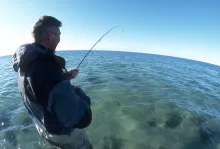
Regarding the dog's ability to cast, he's lost a bit lately, being an elderly dog. But as you can see from this picture he manages to land sea trout fine on a very short and fairly fast stick - and he doesn't need waders either.

Martin


From: kelvin · kkrvp·at·hotmail.com
Submitted April 1st 2009

Nice fly, looks a little like his Omoe brush

2 questions
Where do you buy dog fur??
How far can the dog cast?


From: dik · pinchthebarb·at·gmail.com
Submitted March 31st 2009

This is a great story and a great fly. My wife would tell that most of our dogs fur is on the furniture. I am ususaly the one in the dog house and the dog is on the couch.

Great fly thank you.


From: Magnus Ek · 4.u·at·telia.com
Submitted March 30th 2009

Nice ! I must try my vorsther´s underfur


From: vanuz · gvanuz·at·gmail.com
Submitted March 30th 2009

Works perfect using original Charie´s underfur....


Comment to an image
From: Stephan · die5rists·at·aon.at
Submitted January 7th 2010

Perfect - now I know what to do with the hair of my lab - it's also a brown one!


Want to comment this page? Fill out the form below.
Comment
Only comments
in English
are accepted!

Comentarios en Ingles
solamente, por favor!

Your name Your email
Anonymize my information. Name and email will not be shown with comment.
Notify me on new comments to this article on the above email-address.
You don't have to comment to start or stop notifications.

All comments will be screened by the GFF staff before publication.
No HTML, images, ads or links, please - we do not publish such comments...
And only English language comments will be published.
Name and email is optional but recommended.
The email will be shown in a disguised form in the final comment to protect you against spam
You can see other public comments on this page