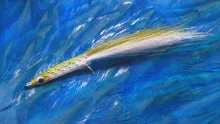
The sand eel or lance - called the tobis in Danish - is one of the most common fish on the Dansih coasts, and is an important part of the diet of especially larger sea trout and cod for that matter. Because of that it is an interesting fish to imitate.
A very common fish
The sand eel or lance - called the tobis in Danish - is one of the most common fish on the Dansih coasts, and is an important part of the diet of especially larger sea trout and cod for that matter. Because of that it is an interesting fish to imitate.
 Unfortunately it is also a difficult fish to imitate. It's pelagic, long - often 20 cm (8") and very slender. It swims fast with ondulating movements of the body, and not only do you need to tie a large fly, but also a very mobile one, that will work in the water.
As you might very well know, movement and soft materials in large flies does not make the easiest casting. I tried some different approaches - tube flies, long wings on short hooks, flies with a body made from dacron backing and more, but never got a satisfactory result.
My latest effort to tie a sand eel has come out better. It's a long winged fly on a short hook. A fly that is up to 20 centimeters long would be impossble to cast on an avarage Danish fly rod, so I decided to shrink the eel a bit. The shortest version is approx. 5 centimeters (2") and the longest one 8-10 centimeters (3-4").

My first experiment with this fly was to tie it as large as possible. In order to obtain a good size and still have a chance of hooking the fish, I had to use two hooks in tandem.
The hooks are connected with a piece of monofile that is thoroughly varnished in order to hold.
| Hook | Short shank, straight eye |
| Thread | Black |
| Body | None |
| Tail | None |
| Wing | Polar bear, white bucktail or synthetics and a few peacock herl |
| Head | Color of thread |
This is a very easy fly to tie:
- Cover one eye width of the hook shank right behind the eye with thread
- Tie in white material, langth 2-3 times shank length
- Tie in a few peacock herl (4-6), 3-4 times hook shank length
- Form a large head, whip finish and varnish.
- Log in to post comments