
This amazing fly is ment for pike. It's caught a lot already on the line of originator Morten Valeur who states that this is one of the few flies he can truly call his own.
Can that catch a pike...!?
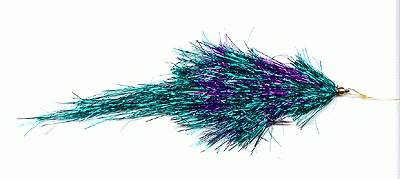
Morten's own streamer in blue and purple
Incredible movement
This amazing fly is ment for pike. It's caught a lot already on the line of originator Morten Valeur who states that this is one of the few flies he can truly call his own.
The material which gives the wet fly an incredible movement is a mylar like type of flash straw, and a single fly comsumes a lot of material. The colors are almost indifferent, but Morten prefers golden and copper colors.

The streamer is best attached with a loop such as this Duncan loop
No body
The pike streamer has a tail and two 'hackle' sections made in dubbing loops. There's no body as such, just the bare shank between the two hackles.
The process of making those is not easy, but with some patience and practice the result will be fine. Use lots of varnish between tying steps. Pike are rough on the flies, and it pays of being a littel meticulous.
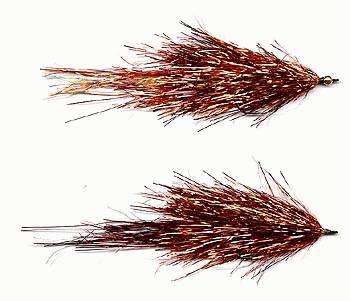
Two golden pike streamers. The lower one has no gold bead which saves some weight.
Materials
| Hook | Large pike streamer hook sizes 2/0 to 6/0 |
| Bead | Large round gold bead |
| Thread | To match materials |
| Tail | Mylar flash 1.5 times hook lenght |
| Hackles | Two times three bunches of mylar strawColor 1 - shortColor 2 - mediumColor 1 - long |
Instructions for wing section:
- Press down the barb
- Slip the bead over the hook bend.
- Start the thread in the rear of the hook
- Cut a bunch of flash in one color and tie in as a tail 1.5 times hook length
- Make a large dubbing loop and attach dubbing spinner
- Advance the thread to the bead behind the hook eye
- Cut two bunches of mylar flash - one in each selected color
- Cut one in the middle and the second in one third and two thirds
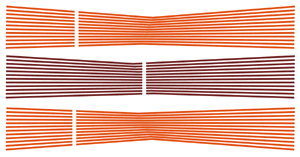
Cut three bunches like this - Save one of the middle sections
- Put a long bunch in the loop close to the hook shank
- Follow by a medium bunch and a short one

The longest bunch is closest to the hook shank - Spin the loop horizontally making shure that the long fibers do not tangle
- Grab the loop in a hackle plier and cut off dubbing spinner
- Groom and order the fibers with a bodkin or needle
- Turn the hackle in close turns, carefully stroking back the fibers
- Unwind the thread to the point where the hackle ends and tie down
- Cut off surplus
- Make a whip finish and varnish the knot
- Advance the thread to a point behind the bead
- Prepare a second bunch of mylar flash cutting it in one third and two thirds
- Repeat the dubbing loop routine this time ending up right behind the bead
- Whip finish, cut thread and varnish behind the bead
- Log in to post comments
