
Swedish Kenneth Boström tied this pattern about forty years ago. I stumbled over it some 15 years ago, but found it too revolutionary

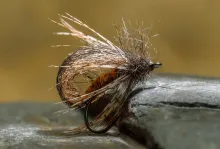
The finished fly |
Swedish Kenneth Boström tied this pattern about forty years ago. I stumbled over it some 15 years ago, but found it too revolutionary. I had just started tying flies and dry flies are, as you know, tied using dubbing, quills and hackles!
Many years later, I fished some fast streams in Mid-Sweden. I could not see my flies. My E:12s and ants drowned and the exciting dry fly fishing suddenly turned into blind flymph fishing. Not my cup of tea.
Fortunately, I had brought my vice and some materials including poly yarn for parachutes. I had brought all the colors including some light olive and light grey.
A small one tied with black body and white wing is a classic, but also olive body and cream wings work well. Some like a front hackle too.
/>I needed a hi-floater which should have the same profile (more or less) as the E:12.
I knew how to tie the Rackelhane, and one afternoon I started threading, dubbing, finishing. I tied some in olive, some in grey and some with olive body and grey wing (advanced, eh?).
Now we started a more controlled dry fly fishing. We fished the rapids for bigger grayling, and we could follow our flies - also in the evening and night (during the summer, nights are very bright in mid- and northern Sweden).
We had great fishing during the night, as Rackelhanen is a dry fly which can be fished actively by twitching the rod or fishing it in the skating caddis style or by pulling in the line in some fast, interrupted pulls, which will take the fly subsurface. At the end of the pull it will start emerging to the surface again, drawing a comet's tail of glittering bubbles, while releasing the air trapped in the wing.
Then it will emerge on the surface with a small "plop".
One day it started raining, the water level rose and the dry fly fishing became less productive. Then we used Rackelhanen as indicator and tied a nymph to the hook bend, so it would dance seductivly maybe half a meter (20") under the yarn caddis.
So, if you are looking for a hi-floating, cheap, easy-to-tie, multi-purpose caddis imitation, you should give this pattern a go.
Go!

Surprised dace |

The dorsal fin of a grayling |

Unhooked grayling |

Step 1 |

Step 2 |

Step 3 |

Step 4 |

Step 5 |
The finished fly |

Top view |
Read Kenneth Boströms original description here . />
- Log in to post comments


Hi Kasper i do like
Hi Kasper i do like this fly going now to have a go, it just looks right . Thanks Jan