
This is a very simple fly imitating the caddis larva. Some may call it realistic fly, some will say impressionistic, but no matter what, the originator says with 100% certainty that it's a killer pattern and he has caught lots of fish with it in many different places.

Dear friends,
It is my pleasure to introduce to you another of my flies - Shark's Caddis Larva.
It is very simple fly imitating the caddis larva. Some of you may say that it is a realistic one. I would say with 100 % certainty it is a killer pattern and I have caught lots of fish with it in many different places.
The idea of the fly came again from nature. When I created it i 2005, I first tried it in a glass of water. The resemblance with the real insect was amazing. I believed that the fly would catch fish even before I went fishing with it. All I had to do was to try it out.
And yes, the fish approved it.
The main trait of Shark's Caddis Larva is the body of twisted Antron yarn with hare's hair.
To make a good imitation of a fly, all you need is to take a close look at the insect you want to imitate. After that just choose the appropriate material to match each element of the fly.
The materials for this pattern as you see are very simple and the tying process also. It doesn't take more than a couple of minutes to tie it.


I fish it like a nymph for trout and chub whit split shots on the leader under an indicator. If you want you may put a weighted wire on the hook when tying the fly, and use two or three of them in Czech style nymph fishing.
I have tried this too. And it works.
Well, let me show you how to tie the Shark's Caddis Larva.
|
|
|
|
|
|
|
|
|
|
|
|


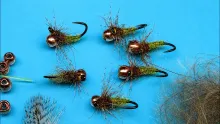
On the picture with the real insect the patterns are tied with brown antron for the thorax. Sometimes I use it instead of peacock herl for the thorax because in some rivers I have fished in Bulgaria many of the insects have browny coloured thorax. There is no matter wich one of those two materials you will choose for the thorax, the fly will still work great.
Have fun!
- Log in to post comments


Rado=
I have tied y
Rado=
I have tied your fly on both 18 and 20 scud hook, used cream colored antron, gray hares under fur and black tungsten bead. The rainbow trout here in Missouri love them, Your pattern is a killer one...thanks and good luck.
Simple and awesome.
Simple and awesome. The picture of them next to an actual caddis is stunning. Well done.
Please send me a lin
Please send me a link to purchase this item, this pattern perfectly matches the caddis larva I saw while fishing yesterday.
Thanks.
Bala
This is cool!
This is cool!
Very nice pattern! S
Very nice pattern! Simple but effective.
Thx for the brilliant and detailed tying instruction.
Bye from Bavaria / Germany
Stefan
Can the shark's cadd
Can the shark's caddis larva be purchased?
HI Rado. With this f
HI Rado. With this fly I started my flyfishing career fortyfive[45] years ago.Back then my materials were fine creme chenille,black 6/0 thread, black rabbit dubbing,tied on 8or10 heavy wire Mustad 3399 0r 3906.I caught so many fish on this fly I retarded my advancement in trying new flys for a considerable long time. I have not as a result fished it for many years. This pattern of yours excites me to ty it and try it. thanks ,it's a great looking pattern,and for your modesty I admire you as well.Tom.
Hi Jack,
For hook
Hi Jack,
For hook # 8 I use about 12 inch (about 30 sm.) of antron yarn. Of course in the end I cut the excess.
Hi, Rob,
Your explanation of making the loop is very precise and true. Thank you for your help!
May be it will be better, if Martin fix the sentence in step 3. Not to be "Make a loop by splitting the end of the Antron.", but "Tie the end of the yarn back on the tail of the fly thus creating a loop".
Guys, I have to apologize for my bad english. It is because my english teacher was a bad girl :)
Good luck!
Rado
Rado, approximately
Rado, approximately how long of a piece of antron yarn do you need for the fly body of the Shark's Caddis Larva?
Thanks for the very
Thanks for the very interesting pattern Rado! It is amazing how close it looks to the real thing.
One thing that seems to confuse a lot of the tyers (as in the comments above) is how the hare dubbing gets tied into the pattern. The video does confuse things.....
To explain it I would say that when you bring the antron yarn down to the tail of the fly leave a 4 inch tag and cut it off. Then tie the end of the tag back on the tail of the fly thus creating a loop. Bring the thread forward. Into the dubbing loop, insert the dubbing material then twist the loop tightly to secure the dubbing into it and tie forward. In the video the tyer splits the yarn and that actually makes it more difficult to twist the dubbing in. By tying a loop with the yarn it becomes what most have heard of as a "dubbing loop"
Once again thanks for the excellent paeetern Rado. Keep up the good work!!
Rado, I have been u
Rado, I have been using the fly this spring and doing well. I modified it some and use Ice Dub Peacock instead of herl. I also tied some with a green Antron body and black Ice Dub UV with a black bead. They work well on native brook trout and wild browns in the streams I fish. This is a great fly. I will take some to Alaska this August.
Without a tungsten b
Without a tungsten bead, the fly will be much lighter, in fast water, you might not get the fly down to the feeding depth.
As for gold beads, the flash can act as an attractor. Getting the fish's attention.
For fish that gets a lot of fishing pressure, a black bead might be better. The fish might get use to the gold flash. The fly don't have so much bling and looks more natural.
Is there an advantag
Is there an advantage of a gold tungsten bead over a black tungsten bead or no bead at all?
the split antron is
the split antron is aa great technique. Thanks a lot..
Hi Wayne,
The sma
Hi Wayne,
The smallest size I have tied the fly is 14, I just have not seen smaller sizes of the real insects in our rivers.
For example, if you look at the picture with the real caddis larva and the two flies in my hand, the size of the hook for the flies there is # 8.
And yes, I use much thinner yarn for the smaller flies, may be one half to one third part of this I had showed, it depends on the size of the fly.
Best regards
Rado
Have you ever gone t
Have you ever gone to a smaller size hook like an 18 or 20 and if so, do you recommend maybe spliting the antron in half so that the fly isn't so fat?
Hi George,
Yes, I
Hi George,
Yes, I use very small amount of dubbing in the original fly. The tier in the video, Fishigan, use much more then me, but it is not wrong if he has good results with the fly tied in his way.
Good luck!
Rado
Very impressive fly.
Very impressive fly. One question. How much hare's ear do you use? In your pictures it looks like you use very little hares ear dubbing. In the video made online the tier use a lot of dubbing. Did the online video use too much dubbing, or the correct amount?
Great fly,
I tie a
Great fly,
I tie a similar style greenwells glory using a naples yellow midge floss and splitting the floss and adding very fine rabbit fur
that gives the fly the same type of killer edge as your fly just scale everything down.
Ronnie .T
Great fly have tied
Great fly have tied them in size 10 to 16 also used pale yellow antron and grey
A great pattern, Its
A great pattern, Its going to be a great clear low water pattern for steelhead in the great lakes. Thanks and good fishing Jim
Your pattern is grea
Your pattern is great, I tied them on sizes 12 - 16 using them for steelhead an is one of my best patterns in low clear water. thanks and good fishing. jim
Dear Bob,
I am ha
Dear Bob,
I am happy you like the fly.
I am sorry that I can not understand your first question, my english is not so good and sometimes I can not understand well what is written. If you are talking about how to make the loop for the body, perhaps you will find some answers in my previous post.
About your second question, If you want to imitate a Hydropsyche larva perhaps my pattern will help you but there is a little difference in the body.
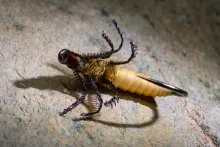
My caddis larva is an imitation of a case caddis larva paterns (I do not know, may be you call it October Caddis) and have gills (as you see on the picture with the live insect) over the whole abdomen part of the body, all over the segments. The Hydropsyche larva's gills are more concentrated on the down side of the abdomen. The upper side of the abdomen have less gills and is smooth and perhaps you will need some smooth stretching tape material for the back, the same that are used for the classic czech (or as Percas said - SLOVAK) nymph patterns.
But if you do not pay so big attention to that as perhaps and the fish will not do as well, you may use green antron and pale yellow, grey, or even white hare's dubbing and make a variation of my caddis larva.
Best regards and greetings from Bulgaria!
Rado
I just saw your cadd
I just saw your caddis larva imitation and i think it looks just like the real thing.WOW....I am so going to tie these in sizes 12-18. I can't wait to use this fly on the famous mother's day caddis hatch on the arkansas river in colorado.about making the loop at the end when applying the hare's fur.out of one stand of antron, do you divide the stand in half and tie it in to form the body, helping you out at the end when dividing the fibers to form the loop. I know this may sound some what confusing, heck its already confusing myself. One more question, can i tie this in a caddis green antron and do you use a pale yellow hares mask dubbing or fur.if so can i still use with the caddis green imitation.
thank you,
Bob DeMoss
Denver,CO
Dear Sasha,
Pleas
Dear Sasha,
Please, take a close look in the pictures of step 5, 6 and 7.
Here on step 5.
I put small amount of hair in the loop.
After that on the next picture, on step 6, here.
I have already wound the thread over the fundament of the body and let it just behind the head.
Now I begin to twist the loop. When it is twisted enough it looks like a thick rope with hair on it.
When I get it that way I begin to wind the hook shank with it to behind the head and then I make some tight wraps with the thread, cut the excesss, make some more wraps and the segmented body is ready, which you see on the picture of step 7, here.
That is all for the body.
If you have any more questions, go ahead, I am here!
Best regards and good luck!
Rado
Rado thank you so
Rado thank you so much.I now understand the process and how to create the body. I have also watched the video you recommend and that has helped enormously.
You see I like the segmentation on your fly as opposed to the segmentation on the fly on Youtube.
Can you explain again how to create the segmentation ?
On your fly, would you say that the segmentation is created by how the yarn and dubbing is tied or is the segmentation created by the thread you use there.
The reason I ask so many details is that I really believe that this fly is one of the most important one I have seen so far. This is the food no fish in the river or lake will refuse if tied and presented correctly. That is why I want to tie it with perfection. That is why I need just a little more of your help.
Many thanks again and all the best.
Dear Aleksander,
Dear Aleksander,
Here, in this link below, you may see a step by step video clip on youtube, made by a guy from USA, known as fishigan.
In the video there, he split the yarn and put some dubbing in it, and after that make the body of the fly.
Well, the original way to make the body is to make a loop by fixing the end of the yarn to the end point of the body of the fly, like it is here on this picture.
You may see there my thumb and forefinger holding the loop, that is made by fixed end of the yarn.
This way, the twisted yarn body is made by two strings and is twice thicker. Also the segments are more precise and distinctive. The other difference is that I like to put spare amount of dubbing in the loop.
But never mind that there are differences in the way that other people like to tie my fly, the result is one and the same, the fish adore the fly. My reward is that everybody who try it is satisfied with the results.
Greetings from Bulgaria!
Cheers!
Rado
I do not understand
I do not understand what happens with split ends I look at the photo but split ends disapear and no explanation is given.
Can somebody help?
I am a new fly tier and from time to time I need just a little guidance.
Most grateful for any help.
Alexander
Very good natural pa
Very good natural pattern, i've already catched some grayling and brown trout in the German Eifel and Sauerland region.
My goodness, this fl
My goodness, this fly of yours is like what I've tied over 35 years ago, but with a slight difference, and yes it was called a 'caddis' at that time as well..the only difference was the hare's fur, and the name of the body material, and I use of a strip of 'latex' to cover and segment the body.....glad to know that we both think alike..............Wolfie..from Canada.
Great fly! The fish
Great fly! The fish in Washington State USA like them.
Nice. Very Nice. Is
Nice. Very Nice. Is there a supplier for this fly? Wholesale?
Is it possible to bu
Is it possible to buy any SHARK flies?Thanks
We have had a lot of
We have had a lot of rain this June and the streams are often cloudy on a good day. This has been THEE killer pattern ! Thank you. PS even just using a brown permanent marker near the bead has been successful.
Radoslav, The patter
Radoslav, The pattern looks good. I will tie this fly soon and i'll try it in Dutch waters (rivers, brooks
and "weteringen" -dutch little canals- ) Besides i was fooled by the picture, i thought it were 3 caddis larva's but it were only two.... Great pattern Thanks!!
Great pattern! thank
Great pattern! thanks Radoslav! Fished it two days ago and trout loved it... the takes were wild!!! Joe I also tried to tie it just like a czech nymph with superfine pale yellow dubbing for dry flies. You may think its crazy but that dubbing turns a bit translucent once in water and try something spiky brown for the thorax, the rest... just catch a lot of fish on it!!!
Cheers!
Radoslav, That's a g
Radoslav, That's a great caddis larva. It looks so real I thought it was going to crawl off my computer screen. I will adjust the thickness of my yarn to match a size 16 hook. Thanks for sharing.
Dear Ruben,
For t
Dear Ruben,
For the step by step pictures of the fly I used hook in size 8 and 4 mm. golden head.
Most of the samples that I find in bulgarian rivers the caddis larvas are in houses made of little stones (gravel) or twigs (little sticks of trees) and when I take them out and measure them they have the size of a fly tied on # 8 hook, but not a problem of course if you make smaller paterns, you have to match the size of your local insects.
The fur hare is very small amount, spread in the loop, just as you said "lightly", you may see it in step 5.
Best regards,
Rado
Awesome! Trying to r
Awesome! Trying to replicate a caddis larva...Hot Creek, Eastern Sierra CA. This is the pattern that fits perfectly...wish I can post a digi.pic of my live sample. Anyhow, how much of the hare fur do you use & the size hook? I am using a TMC 2457 (heavy) size 14 hook w/ a Killer Caddis glass bead (root beer) as the head. It seems that the hare fur should be used "lightly". Thanks again for a fantastic pattern!
From Los Angeles (only 5 hours away to fly fishing),
Ruben
Hi everybody,
I a
Hi everybody,
I am happy you lik the fly, I hope your local fish like it also.
Joe, I did not try the fly with another material then yarn. I use yarn because it is made of many thin strings. It is smooth, shiny and very easy to work with. If you want you may try with floss or some kind of poly yarn or other material which are sold for wings, may be they will works too.
I wish you all the best!
Sincerely,
Rado
what would be a suit
what would be a suitable replacement for the yellow antron yarn? I can only find antron dubbing here in the states.
thanks
Jerry,
Yes, Rado'
Jerry,
Yes, Rado's caddis is an excellent imitation, and certainly worth trying.
Regarding the reprinting of the article, you'd have to ask Radoslav himself, but the general rule here on GFF is that we don't reprint other people's stuff, and we prefer if they don't reprint our's. The web has enough unoriginal material floating round already, and repeating what others have already published once is not something, which we endorse. We would greatly prefer to see something new and yet unpublished on your site.
Martin
That caddis larva wa
That caddis larva was so realistic and so simple that even I could create it. I would love to put that article in my blog if you would grant me permission. I would be most happy to give you full credit for writing it. My site at Troutu.com has a link to GFF.
My instructor is a m
My instructor is a master at her work, just as I suspect of you. I'm just a beginner, but will one day have my own to show and teach. Just looking at your work inspires me that much more to be the best. Thanks for displaying some great flies.
Congratulations on a
Congratulations on a super realistic caddis fly and so easy to tie. I will try it in my Argentine rivers soon!
www.andesoutfitters.com
Outstanding fly. lo
Outstanding fly. looks very real and productive.
yes, yes...good work
yes, yes...good work, bud no CZECH style nymph, clear SLOVAK style nymph, show my photoalbum...
aloha from SLOVAKIA :-)
Absolutely perfect!!
Absolutely perfect!!! These flies look like live.