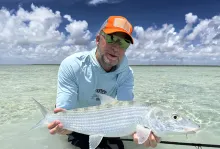
Tom Gorman admits that he's brought a 12-wt. outfit along on fishing trips to various parts of the world where sailfish are present, but the opportunity for him to present a fly to a sail just never seemed to happen. Until during his recent trip to Guatemala.
For longer than I’d like to admit here, I’ve brought my 12-wt. outfit along on fishing trips to various parts of the world where sailfish are present, along with other pelagic species, but the opportunity to present a fly to a sail just never seemed to happen.
If fly rods were candidates for airline loyalty points programs, my 12 wt. would be in the platinum club. I’ve caught plenty of other saltwater species on it, but I purchased it with sails in mind. Not long ago, I decided to break the voodoo spell and get serious about sails on the fly.

Although based in Hong Kong, I’ve fished a fair amount in Mexico and other spots in Central America. The fishing in Mexico is world class, and charter rates are very affordable, but the conventional wisdom among most local skippers is that fly gear does not qualify as big fish gear. There are now a handful of fly-savvy skippers and guides in Mexico including some truly excellent ones, but most local skippers remain fly skeptics at heart. They also lack the expertise to coordinate fly fishing for billfish, which necessitates more team effort between the angler and the crew, especially prior to the hook-up, than other types of offshore fishing.
As reported on the cover story of “Sport Fishing” magazine’s February, 2011 issue, Guatemala offers one of the best concentrations of sailfish on the planet. By pure coincidence, as I read this issue of the magazine I was sitting on an airplane en route to Guatemala. This seemed a good omen.
My trusty and well-travelled Sage Xi2 12 wt. and Abel Super 12 were in the cargo hold along with a box of flies and a 10 wt outfit in case we got some shots at dorado offshore or roosterfish inshore.
I’d chosen February because the winter months offer good numbers of sails, some marlin, and some dorado in waters near Iztapa, where I planned to stay. Although we get all three species in waters offshore of Hong Kong, the sails and marlin are not plentiful enough to make fly-fishing for them a viable option.
After a thorough online search, I chose Sailfish Bay Lodge, for its proximity to prime fishing waters, commitment to serving fly anglers, and the number of positive angler reviews I read about it. I also like the fact that they publish a weekly tally of billfish raised and released, fly and conventional, on their website - www.sailfishbay.com..
Sailfish Bay is less than two hours’ drive from Guatemala City, followed by a five minute boat ride to its island location. It’s small, friendly, and very professionally run. The food is great, boats and crews first class, rooms comfortable, and it offers a nice beachside pool.
I fished from a 34 foot Blackfin named Maverick, skippered by Captain Rolando, with Noe and Ronald as his able crew and deckie. That first morning, we left the marina at 7:30 a.m., and had teaser lines in the water by 8:00. It was already very hot, with seas nearly flat calm. We headed due south, in the general direction of El Salvador. As I looked back at shore I could clearly see three volcanic peaks on the horizon, two of which are active.
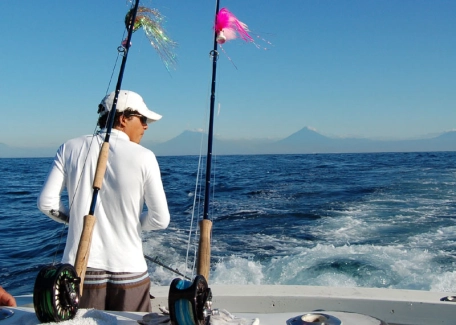
The spread consisted of three hookless teasers on the starboard side, with two deployed off the outrigger and controlled from reels mounted next to the skipper on the bridge, and a longer line straight back from a rod holder in the starboard gunnel. Another hookless teaser ran from a rod in a port side rod holder. A couple of heavy-duty spinning rods were rigged and ready with hookless pitch baits on ice in the cooler. Teasers were a mix of ballyhoo, mullet, and belly strips cut from dorado or bonito. Squid is sometimes used as well.
The casting corner of the boat for me as a right-handed fly caster was the port stern. To keep a clear area for the backcast, the port side outrigger is not deployed.
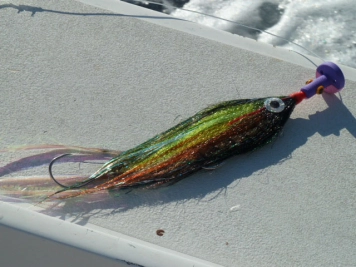
Although the “go-to fly” here is a Cam Sigler offshore popper in pink and white, my fly box had several offerings which caught skipper Rolando’s attention, and we deployed a 10-inch flashy profile fly in green-gold-black with a pink and purple popper head attached on my 12 wt., and the Cam Sigler favorite on the 10 wt.
Hardly one hour from the marina, after we found some nice color lines, Rolando shouted “Vela ! Vela !” – “Sail ! ” in Spanish. The skipper and crew sprung into action, retrieving teasers to bring the fish into fly casting range, preparing to cast a fresh pitch bait if needs be. But this first fish cruised in and out of the spread quickly, offering no casting opportunity.
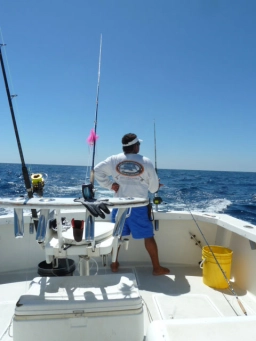
Seemingly only seconds later, the sail was back in the spread. This time my eyes were better attuned – good polarized shades are absolutely essential – and I got a good look at the fish as he followed the teaser in.
And then, with the sail 15 to 20 feet back from the stern and trying to gobble the teaser, the crew yanks the teaser out of the water, and the fly caster gets that all-important single shot at dropping the fly to the outside of and behind the sailfish, and then giving it one or two “pops.”
Dropping the fly in this position increases the odds of a hookset opportunity with the fish swimming away from the boat rather than towards it – offering a much better chance of success.
The sail inhaled my green and gold flashy profile fly, and I set the hook with a slow, deliberate lean in the opposite direction from the one the fish was swimming in. The hook-set technique for billfish on the fly is the subject of two schools of thought, one being the forceful “lean away” and the other favoring more of a strip strike approach. Having tried the latter and broken off several times, I’d become a proponent of the “lean” school.
Hook-up ! With line racing off the spool, fortunately I had the presence of mind to recall some advice offered by Billy Pate in his DVD on fly fishing for sailfish. He points out that by keeping your fly rod low and nearly parallel to the water’s surface, you have better leverage and ability to turn the fish’s head than you do when the fish is deep and the angle of your line is steeply downwards.
Pate calls fighting the fish in this way “giving him the down and dirty” but it is actually doing both the fish and the angler a favor because it shortens the length of the fight.
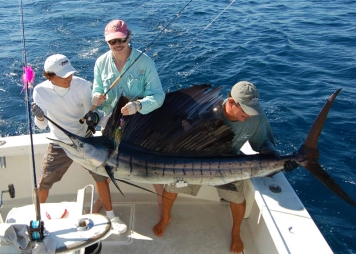
My first sail on the fly came aboard the Maverick about 20 minutes later for a brief photo opportunity followed by a healthy release. All in all, a very satisfying first hour on the water in Guatemala.
- Log in to post comments