
Tom Kirkman's book "Rod Building Guide" is a cover-to-cover brain dump of the author's experience building all manner of fishing rods. He doesn't tell the reader as much how to do things, as he does why, and almost as importantly, why not.
Global Class
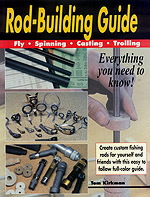
Rod-Building Guide
Tom Kirkman
Frank Amato Publications
February 2001
Paperback, 51 Pages
ISBN: 1571882162
Suggested retail: $14.95US
As the title suggestion, Tom Kirkman's book "Rod Building Guide" is not a hand holding, let's walk you through your first project, do it my way type of book (in spite of what the subtitles on the cover would lead you to believe).
How refreshing.
What this book is, in fact, is a cover-to-cover brain dump of Tom's experience building all manner of fishing rods. He doesn't tell the reader as much how to do things, as he does why, and almost as importantly, why not. While there is plenty of basic instruction, the book earns its cover price with the in-depth information passed along to the readers so they will be ready when they stumble across their own rod building problems. He demonstrates with ease that in many cases, information is far more valuable than instruction.
Tom recognizes the fact that sometimes information is more valuable than instruction.
Take the chapter on spine, for example. It would have been easy for Tom to say "bend the rod, find the outside of the curve. That's the spine. Place your guides along the spine". That's how it's done in many books and instructional materials. Tom goes the extra mile, however, and explains what the spine is, how it is created as a side effect of the blank construction process, and how it relates to the performance of a fishing rod. Not once does he tell you where to place the guides on the blank. He gives you enough information to decide for yourself, based on the intended use of the rod. He also takes the time to deal with some common conceptions (and misconceptions) of rod spine - how it may (or may not) affect the stability of a rod under stress and how it can influence a rod's casting performance. This is the most clear and concise dealing with rod spine I've ever seen in print, or anywhere else for that matter.

The discussion of modulus is similar. He tosses aside all the marketing mumbo jumbo and gives a practical meaning to "modulus" in the world of fishing rods to help people select blanks that will best fit their fishing needs. He boils down all the physics and hype into clear, concise, easy to understand ideas. You won't see Tom ever make the claim that "IM6 graphite rods are the best".
I could go on, but you get the point. Tom isn't going to walk you through your first rod building project, filling in every detail along the way. There just isn't enough space between the covers. He chose the "generic" approach to rod building, not so much concentrating on one facet such as fly rods, but treating rod building as a general craft and supplying knowledge and information that's applicable across the board, while offering specifics where necessary and appropriate.
Some fly anglers who might be interested in building fly rods might look at the cover of this book and sniff "that's for the fancy butt wrap metal flake bass boat crowd", which would be a terrible injustice. Not only does he present fly specific information, but the book as a whole contains information absolutely appropriate to all manner of fishing rods - fly rods included. If the book has a weakness, I'd say it's the very characteristic I applauded earlier, the abundance of background information and the thrift of specifics. Beginners especially might wrestle with "finding the forest through the trees" with a book filled with so much
information. It may have been worth Tom's (and the publisher's) time to put a little summary box of "trees" at the conclusion of each chapter, offering a specific recommendation of a technique, tool, or material that Tom knows won't lead a new rod builder astray.
- Log in to post comments
