
I purchased a copy of Skip Morris' book on tying flys for bass and panfish and another of his books on foam flies. His books are excellent and I recommend them above all others for beginning tyers. The pictures and instructions are superb!
I purchased a copy of Skip Morris' book on tying flys for bass and panfish and another of his books on foam flies. His books
are excellent and I recommend them above all others for beginning tyers. The pictures and instructions are superb!
Skip's book is my inspiration.
A popper I bought and used last summer was yellow in color, with long rubber legs and yellow marabou tail. I've used foam, ostrich herl and rubber legs to closely approximate my purchased "popper".
Materials:
| Hook | 12-16 down eye wet fly hook |
| Weight | Brass bead |
| Thread | Yellow |
| Tail | Yellow marabou and flash (optional) |
| Body | Tying thread and a strip of foam on the top |
| Back | Strip of yellow foam |
| Legs | Yellow or white rubber legs |
| Thorax/head | Peacock herl covered with brown foam |
| Eyes | Clear glass beads |
- Tying instructions:
- Press down the barb
- Tie in a tuft of yellow marabou as a tail. Length approx. 11/2 times hook shank.
- Cut a narrow strip of yellow foam
- Tie in the foam on top of the hook shank. Leave space for eyes and head.
- Wind the thread forwards over the foam.
- Fold the rear half of the foam forwards and tie down
- Cut surplus
- Tie in two rubber legs as an X. Length approx. as tail
- Cut a narrow triangle of brown foam
- Tie in foam over hook eye pointing forwards
- Tie in the eyes on top of the hook shank
- Cover the base of the eyes and underside of head with peacock herl
- Fold the brown foam tightly backwards over the head
- Tie down and cut surplus
- Whip finish and varnish.

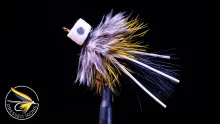
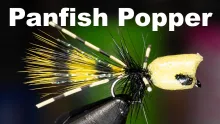
The foam fly. Notice the shape of the brown foam

A fly with flash in the tail.
Panfish
Panfish is a broad category for fresh water fish approximately the size of your hand. They are found largely in lakes and farm ponds and include bream, crappie, sunfish, etc. They are different from small mouth bass, large mouth bass, and striped bass. When I was a small boy of 10 years or so, my Dad would take me to a
pay-for-fish pond close to our house. He would fish for bass, carp, catfish, etc. I took a cane pole and would sit close to the supply water feeding this small pond. Generally, I out fish my Dad by catching lots
and lots of "panfish". These were treasurable times and will always be remembered fondly.
I'm 45 now, trying to give my kids (two boys) some of the same rememberances given to me. Last summer, I camped at Boy Scout Camp John J. Barnhardt with my eldest son. I'd restricted myself to trout fishing until this week long encampment. Knowing that Camp Barnhardt is located on Badin Lake, NC, I carried my fly rod and purchased some "popping bugs" as I didn't know how to tie flys for small fresh water fish.
On a Thursday afternoon, in a matter of two hours, I caught 18 "panfish".
They hit hard. It was another memorable experience.
- Log in to post comments


Under the foam
Pat,
The brass bead is under the foam on the hook shank, while the eyes are in the front of the fly, where you'd expect the eyes to be. Omit the bead and the fly floats. Add the bead and the fly sinks slowly.
Martin
Brass bead
The pattern above calls for a brass bead and glass eyes Is this correct
Thanks for the foam
Thanks for the foam fly. I tye it in a larger size with shorter legs and red fish love it also
Cheap Lazy Bastard
Guy,
To find the Cheap Lazy Bastard, use our search facility and you will notice that it's the first article listed in the results. Smart, huh?
And if you by email-distribution mean a newsletter, we have none. Subscribe to our RSS-feed or visit regularly to get the updates.
Martin
I found this page by
I found this page by searching for "Fly Fishing yellow foam bug"
This is a great website. I came back to it minutes after I printed what I had asked for and was looking for "Cheap Lazy Bastard" June 5th 2006..... it vanished.
How can I find it again and how can I get on your e-mail distrubution?
Thanks
Guy Groulx Fort Worth FlyFishers
Nice silhouette
Nice silhouette on this fly very nice pattern. Bet its great for panfish!
What do you mean?
Jack,
What do you mean "too many sites are non-exsitent"?
Links to other sites from this page? Not so! I just checked the links, and they seem to work. What other people do with their sites is out of our hands, but we try to preserve every page intact eternally... almost.
Martin
Non esistant
too many sites non esistant, clean up old sites