
George F. Grant's flies utilize some very special techniques.
The hallmarks of Grant's flies are the woven hair hackle and a body covered with flat mono-nylon.
Weaving the hackle: A strong tying thread is doubled and stretched tight between two vices. Tie an overhand knot on the doubled end approx. 5 cm (2") and place the loop over a needle fixed in the left vice. The thread must be as tight as its strength allows.


A small bundle of hair approx. 3 cm (1.5') is fixed by their buts between the jaws of a hackle plier. The length depends on the size of the hook on which it is later to be tied.
The bundle is then twisted around the doubled thread as shown on the drawing. When finished it's tightened and pressed to the left against the knot. Take good care, that you don't wear it too much or twist the thread.

When this is done right all buts are on one side and all the tips on the other.
Continue the process with 15 to 20 bundles.
The hook can be a Mustad 79580 #6 - a longshanked trout hook. The tying thread must be well waxed and is tied in 5 mm (1/5") behind the eye of the hook. Turn the thread in tight turns to 5 mm in front of the hook-bend and then back again.

Now you must fix two small pins on each side of the hook shank. They shouldn't be longer than 15-16 mm (approx. 5/8") - if they are longer they will leave no space in front for the hackle and head. Tie in one needle at a time from close behind the head of the pins and backwards.
Just in front of the bend of the hook you tie down a 40-50 cm length of flat monofilament (0,50 - 0,60 mm in width), and after that a long piece of floss silk. If you don’t want to use only floss silk, then you can start with darning wool and then as the last step tie a piece of flossilk down behind the pin-heads - turn it back to the bend and back to cover the yarn.
Then the tails - 3 in number - are tied down - they can be badger-hair. When the tails are in the right position, turn the tying silk back to close behind the head of the pins. A smooth tapered body is formed with the flossilk - try to keep a very tiny space clear behind the pin-heads - we will need that later!

If you don’t want to use only floss silk, then you can start with darning wool and then as the last step tie a piece of flossilk down behind the pin-heads - turn it back to the bend and back to cover the yarn.
Having finshed the floss body you cover it with a thin layer of clear varnish on the back. In this layer you can place a Jungle Cock feather or the beautiful blue feather from a Jay. Take care that the colour of the floss corresponds with the colour of the feather. I have also with success tried feathers from Cock Pheasants.
There are wide possibilities for experiments!


Now the flat mono-nylon is turned in tight turns up over the shank - take care that it doesn’t twist. It is tied down directly behind the pin-heads - not in front of them!
The woven hackle is tied down 5-7 mm in front of the pin-heads - not closer or you can’t give them the right angle to the rear.

It’s turned just like a doubled cock-hackle - one turn in front of the preceeding one much like the technique used for ostrich herl on a salmon fly.
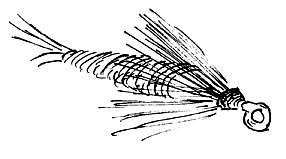
You finish with a nice conical head, which you perhaps can give a coat of red lacquer, so that it can look like the original flies.

Hand picked for this article

- Log in to post comments
