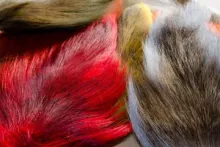
Recently I've begun working with a material that was introduced to me through the tying of Dave Whitlock. In particular, his "sheep series" of baitfish flies. It's Icelandic Sheep Hair, although some distributors refer to it as "Streamer Hair" or "Secret Streamer Hair". I've found it to be a wonderful tying material for large streamer type flies.

Recently I've begun working with a material that was introduced to me through the tying of Dave Whitlock. In particular, his "sheep series" of baitfish flies. It's Icelandic Sheep Hair, although some distributors refer to it as "Streamer Hair" or "Secret Streamer Hair". I've found it to be a wonderful tying
material for large streamer type flies.
For those of you not familiar with it, it is a natural hair from an Icelandic sheep. The hairs are between eight and ten inches long, with a soft underfur that's six inches long or less. The colors are dyed from white and the results are very very bright. In fact, I have a fluorescent yellow that I would swear is a synthetic, as it just glows so brightly.
One quality of the material that I like very much is that you can give an illusion of substance to a wing without using a ton of material. It's "fluffy", yet absorbs water and will sink readily when fully wet, unlike some other materials. It holds it shape underwater very well, so you can be confident that the results at the vise will be similar to what is observed when the fly is fished.
Another fine point is how it compresses so well at the tie in point, thus allowing you to stack colors without causing excess bulk. If you've ever tied bucktail flies that have multiple layers (such as Mickey Finns or a Black Nosed Dace), you know how hard it is to keep a neat and tidy head and to keep the colors separated. With the sheep hair, it is very easy to build a complex wing, as it compressed down so well and only a few wraps of thread are required to secure the material to the hook shank.
In the water, this stuff has EXCELLENT mobility. Much more so than bucktail. I haven't fished these flies yet, but I have given them the tub test. Side by side with a similar sized bucktail fly, the sheep hair fly was much more "alive". When I compared the two flies when fully soaked, the sheep hair fly definitely felt to be lighter than the bucktail fly. It seems that the fly will be very easy to cast with a 6wt rod, even using a fairly heavy hook (TMC 9394 #2). And it holds its shape well under water, even when stripped quickly.
It's very easy to work with and there is very little waste per package. The price is similar to a "premium grade" bucktail (if you can find one), at about $3.25US per package, but I believe there are many more flies you can get out of each package of sheep hair than you can from a single bucktail.
Obviously I can't comment on the material's durability yet, but given the feeling I got trimming it off the hide with scissors, it feels fairly sturdy. Time (and fishing) will tell. The only drawback I've seen so far (without fishing the flies) is that it takes a bit of time to soak up water. It would probably pay to "pre soak" the flies prior to fishing them, otherwise you're going to cast a few floaters before they absorb enough water to sink properly.
The flies I initially tied were based on Whitlock's sheep series of baitfish flies. The first fly is in fact very close to one of Dave's patterns, with a couple substitutions. It doesn't mimic a particular baitfish, but rather uses the theme of Dave's flies with a color pattern I've found particular effective on largemouth bass (chartreuse and white).
| Hook | TMC 9394, #2, Bent to form a "bendback" shape | |
| Thread | White 3/0 monocord | |
| Gills | A small ball of red SLF dubbing about mid shank | |
| Underbody flash | Pearl Krystal Flash | |
| Belly | White sheep hair | |
| Mid Wing | White sheep hair | |
| Lateral Line | Silver flashabou | |
| Wing/Back | Flo Yellow Sheep Hair under Grey Sheep Hair | |
| Topping | Peacock Krystal Flash | |
| Sides | Grizzly dyed Chartreuse Hackle, one strand of pearl "holographic" flash | |
| Cheeks | Woodduck flank | |
| Eyes | Solid plastic, gold |
The following tying steps are my interpretation of the procedures demostrated on Dave Whitlock's "Tying Bass Flies" videotape:
- Take the hook in hand and make a bend about 3/16's of an inch behind the eye to shape the hook into a "bend back" style. This will help the hook ride point up, thus making it essentially weedless.Insert the hook point up in the vise.
- Start the thread behind the eye and wrap about halfway down the hook shank.
- Dub a small amount of red dubbing onto the thread and form a small ball of dubbing to simulate the red glow of gills on the finished fly. Pick this out a bit with a dubbing picker or apiece of velcro. A little dubbing is all that is needed.
- Advance the thread to the point where the hook bends and tie in the underbody flash consisting of 4 or 5 strands of krystal flash, a portion on top extending beyond the hook point to short short of the planned wing length, and a portion below the hook shank to just short of where you want the belly to end. In addition to adding some "inner glow" to the finished fly, these set upthe proportions for adding the rest of the materials. And remember,since the fly rides point up, the belly of the fly is on the side of the hook shank opposite the point.
- Cut a small section of sheep hair close to the hide. Holding it by the trimmed butt, grab the bunch near the tips and begin pulling out the longer coarse hairs until what is remaining is as long as you want for the body of the fly. Tie this in as the"mid wing" on top of the flash.
- Prepare slightly smaller clump of deer hair and pluck out the hairs until the bunch is about half as long as the mid wing. This will be used for the belly. Tie it in below the under body flash.At this point, you can see the general shape of the fly starting to take form.
- Take several strands of flashabou and tie them on top of the mid wing bunch of sheep hair, not quite reaching the tips. This will form the inner lateral line of the fly.
- Prepare another two more bunches of sheep hair as you did the first and tie them in on top of the flashabou, thus completing the body of the fly. You can see now how the fly is shaped like atypical baitfish, thin side to side, thick back to belly, with a tapered shape head to tail. You can optionally add a topping of krystal flash on top of the wing, but since it tends to "flyaway" from the rest of the body, I usually leave it out. There's already plenty of flash in the fly.
- Since this material is so translucent, it is necessary to add some material along the sides of the fly to improve its presence in the water when wet, so we add a hackle along each side, not quite reaching the end of the tail.
- On top of the hackle, I like to add a single strip of a fairly stiff flash material as a final "lateral line". Something like holographic flash is excellent as it has wonderful prismatic reflective properties, yet isn't so limp that it will fall out of place when fished. Dave uses a piece of pearl mylar under the hackle, but I like it outside the hackle.
- Now it's time to finish the head of the fly. Two curved woodduck flank feathers will simulate the head of the fish, and two solid eyes add that final touch of realism. Make the head roughly a fourth as long as the body.

Bob Petti's Sheep Hair Fly
Yeah, it might be a fairly complicated fly, but that's ok. It's no more complicated that some of the exotic hardware the B.A.S.S. guys are tossing with bait casting tackle. And if you enjoy tying flies, then tying a dozen of these is as fun as it gets. They don't take long to tie, but the end results are wonderfully exciting baitfish flies that just reek of fishability. Along with Dave's published patterns (sunfish, shad, crappie), these flies could be tied to imitate all sorts of bait fish (alewife, perch, juvenile bass, etc.) as well as non-imitative attractor patterns like the one I listed above. The only limitations are the colors of the material available, but it appears to take a dye well so that could remove that limitation if you care to dye your own. And those flies are just variations of a single theme. I imagine using this stuff on clousers, as the tail on mega-divers, anywhere I want to give the illusion of "bulk" without creating a fly that is difficult to cast effectively. One problem fly fishing for species like largemouth bass and pike is that productive flies tend to be quite large. If you're not careful when choosing materials, you can wind up with flies that either cast like a kite or like a wet sock. Using synthetic hairs is one possibility, but I've yet to find any that appeals to me like a natural hair will. So far in my search, this Icelandic Sheep Hair is far and away my favorite for tying large warmwater subsurface flies.
Another kudos to Dave Whitlock. Thanks Dave!!
- Log in to post comments