
Kieth Fulsher was particularly concerned with the size of the head and the eyes. He didn't feel that thread heads with painted eyes or jungle cock eyes appropriately represented the large head of a minnow.

Introduction
Keith Fulsher is a flyfisherman living in Eastchester, New York. Early on he tied flies for the renown Angler's Cove in Manhattan. There he came into contact with Lew Oatman, another tier who contributed greatly to streamer design, and with Alex Rogan a descendant of the Scottish Rogans who were established tiers and deeply involved in Atlantic salmon fly design.
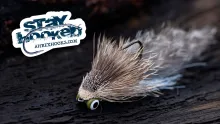
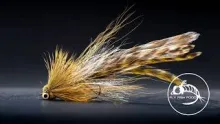
In 1962 he started to experiment with constructing streamers that would more exact imitate bait fish. Unsatisfied with the bulky and gaudy streamers then available he set about creating a sparse and streamlined minnow imitation. He was particularly concerned with the size of the head and the eyes. He didn't feel that thread heads with painted eyes or jungle cock eyes appropriately represented the large head of a minnow.
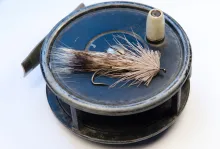
The style he settled upon had been employed earlier, the reversed bucktail. This style involved tying bucktail onto the hook shank behind the eye so that the tips projected forward of the hook eye. The bucktail butts were then secured to the shank and wrapped to the eye. The free ends were bent back over the shank and secured so that they now projected beyond the hook bend. This reversed bucktail style results in a substantial head and allows for large sized eyes.
The reversed style was not new. His style evolved from wet flies he had seen as a young angler. These had feather wings tied with the tip projecting forward beyond the eye. The stem was then bent back over the shank and secured again. Here the intent was to promote a secure attachment. In fact this style goes back even further. Mary Orvis Marbury includes several reversed head flies in "Favorite Flies and Their Histories". An early practitioner of this style was Carrie Stevens who used this design for saltwater flies.
Fulsher's real innovation and contribution was the creation of a series of imitative flies that matched the form and coloration of local baitfish.
He tested these patterns initially on Thunder Creek in northern Wisconsin, a low flow, tannic, small stream which is interrupted by beaver ponds.

Materials (In general)
- Hook : 6 X long, ring eye, typically in sizes 2 to 8 but ranging as far as 4/0 to 12 where appropriate. Partridge CS5, Mustad 36620 and Daiichi 2460 are similar and have all been used traditionally for tying the Thunder Creek flies.
- Thread: Red. This simulates the open gills.
- Bucktail: Fulsher's preference is for hair from the bottom half of the tail.
- Body: Embossed silver or gold tinsel or floss as required.
- Eyes: After the head is formed, it is coated with lacquer or epoxy several times to form a smooth head. Then a yellow spot is applied and when dried a black pupil is added. Another coat is the applied to protect the eyes.
General Tying Instructions
These streamers employ either two or three colors of bucktail. Typically a dark color forms the dorsal surface, a difference color represents the midline and a light color serves to mimic the belly of the fish.
- Attach the tread and cover the body with tinsel or floss.
- If a midline is called for, attach the bucktail which will form the midline.
- Tie in a small bunch of bucktail by the butts behind the eye of the hook such that the tips projects toward the bend. The tips should project just beyond the bend of the hook. The remaining bunches of bucktail should be approximately 130 percent of the hook shank length.
- For the top of the fly select a bunch of dark bucktail about the thickness of a wooden match. The bucktail is aligned along the top of the shank such that the tips are forward of the eye and the butts end at a point 20 percent of the distance from the eye to the bend. The butts are wrapped up to the eye.
- For the bottom of the fly either rotate the hook so that it is upside down or take the hook out of the vise and put it back in upside down.
- To the bottom of the shank attach the light colored bucktail as for the dosal bucktail, i.e. the bucktail is aligned along the the shank such that the tips are forward of the eye and the butts end at a point 20 percent of the distance from the eye to the bend. The butts are wrapped up to the eye.
- The thread is then wrapped back to the end of the butts. Return the hook to its upright position.
- Now the top bunch of dark bucktail is bend back over the top of the shank and adjusted so that the hair covers the top of the shank but leaves the midline visible.
- Next the light colored bunch on the bottom of the shank is reversed. Be certain to maintain a clear color separation. The dark bucktail on the top of the hook should lie along the top, the midline should be visible and the lower bucktail should run along the bottom of the hook shank.
- The thread which is one fifth of the way back from the eye is then wrapped over all of the bucktail and whip finished in place. The twenty percent between the thread wraps and the eye of the hook forms the head of the fly. The wraps over the bucktail are made with red thread and are representative of flared gills. The tip ends of the bucktail should reach just beyond the end of the hook bend.
- Cover the head with several coats of clear lacquer or epoxy.
- After it has dried a spot of yellow lacquer is applied and, when dried, a black pupil is added. The head is then coated again to protect the eyes.
Considerations for Tying
Fulsher noted that these patterns could be weighted if the situation warranted. While tying examples of these patterns I have noted a few observations that inexperienced tiers might take into consideration.
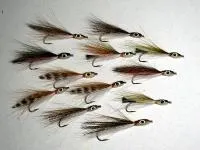
The first is head size. All of the patterns depicted here were tied on size 6 hooks. Fulsher indicates that the head should represent approximately 20 percent of the shank length. The examples he provides in his illustrations give the impression of a head size which is much slimmer and longer than the ones shown here. This probably results from his use of a larger hook size and from his coating with lacquer. In the flies shown here the heads were coated with epoxy which would give a thicker coating and thus produce a more rounded head. The epoxy coating gave a smoother surface on which to paint the eyes and was consequentially used for that reason.
Several of the patterns call for use of bucktail from the dark center strip of the tail frequently the dark strip dyed a specific color. This part of the bucktail is very often much shorter in length than the white hairs on the side and ends of the tail. In several cases it was difficult to find sufficently long, dark hairs for the flies. It would be advantageous to carefully select the bucktails used for these particular patterns.
Acknowledgements
This article was inspired by the excellence of Keith Fulsher's book and the disappointment that this salient contribution to streamer design is not better known and not more widely available.
Bibilography
Keith C. Fulsher. "Tying and Fishing the Thunder Creek Series" Freshet Press Inc, Rockville Center, New York, 1973
Keith Fulsher. "Keith Fulsher" In: (editor, Judith Dunham) "The Atlantic Salmon Fly". Chronicle Books. San Francisco p. 78-81, 1991
Keith Fulsher. "Saltwater Thoughts Revised" The American Fly Fisher 24 (3): 2-6, 1998.
Patterns
Keith Fulsher created patterns mimicking the most common baitfish. The baitfish and the pattern for it are listed below:
Blacknose Dace

- Hook Shank Covering: embossed silver tinsel
- Lateral Stripe: black bucktail
- Top of Head and Back: brown bucktail
- Bottom of Head and Belly: white bucktail
- Eye: Yellow lacquer with black dot
- Additional Comments: Draw a black line on the head from the hook eye to the rear of the head
Emerald Shiner

- Hook Shank Covering: flourescent green floss with silver or green tinsel rib
- Lateral Stripe: none
- Top of Head and Back: brown bucktail
- Bottom of Head and Belly: white bucktail
- Eye: Yellow lacquer with black dot
- Additional Comments: Fulsher reports using this pattern most often. In recent adaptations he uses pearlescent flashabou for the body.
Golden Shiner

- Hook Shank Covering:yellow tinsel
- Lateral Stripe:yellow bucktail
- Top of Head and Back: brown bucktail or brown part of a green or blue bucktail
- Bottom of Head and Belly:white bucktail
- Eye:Yellow lacquer with black dot
Marabou Shiner

- Hook Shank Covering:embossed silver tinsel
- Lateral Stripe:none
- Top of Head and Back: silver pheasant crest feathers (black)
- Bottom of Head and Belly:white marabou
- Eye:Yellow lacquer with black dot
- Additional Comments:This pattern is the only one that does not imitate a specific species of baitfish. Rather it serves to represent the general class of shiners and is a good second pattern for the common shiner. The marabou tip is cut off and the barbs of marabou are trimmed on the head before lacquering.
Rainbow Trout

- Hook Shank Covering:embossed silver tinsel
- Lateral Stripe:pink bucktail
- Top of Head and Back: brown part of bucktail dyed green
- Bottom of Head and Belly:white bucktail
- Eye:Yellow lacquer with black dot
Redfin Shiner

- Hook Shank Covering:pink or red flourescent floss and a silver tinsel rib
- Lateral Stripe:none
- Top of Head and Back: brown bucktail
- Bottom of Head and Belly:white bucktail
- Eye:Yellow lacquer with black dot
- Additional Comments:This is the adult male of the common shiner in its spawning colors. This species can grow up to eight inches in length.
Silver Shiner

- Hook Shank Covering:embossed Silver Tinsel
- Lateral Stripe:none
- Top of Head and Back: brown bucktail
- Bottom of Head and Belly:white bucktail
- Eye:Yellow lacquer with black dot
- Additional Comments:This design represents the female and immature common shiner
Smelt

- Hook Shank Covering:embossed silver tinsel
- Lateral Stripe:orchid bucktail
- Top of Head and Back: brown bucktail
- Bottom of Head and Belly:white bucktail
- Eye:Yellow lacquer with black dot
- Additional Comments:Smelt can reach fourteen inches but typically average seven inches in length.
Spottail Shiner

- Hook Shank Covering:gold tinsel with a black floss caudal spot
- Lateral Stripe:none
- Top of Head and Back: brown part of a bucktail dyed green
- Bottom of Head and Belly:white bucktail
- Eye:Yellow lacquer with black dot
Strawcolor Shiner

- Hook Shank Covering:embossed silver tinsel
- Lateral Stripe:blue bucktail
- Top of Head and Back: brown bucktail
- Bottom of Head and Belly:white bucktail
- Eye:Yellow lacquer with black dot
- Additional Comments:This is also know as the sand shiner.
A second series of streamers was also developed for less widely distributed baitfish. These patterns are below:
Reddup Shiner

- Hook Shank Covering:black floss tail black floss with gold tinsel,orange floss fins
- Lateral Stripe:pale-yellow bucktail
- Top of Head and Back: black bucktail
- Bottom of Head and Belly:pale-yellow bucktail
- Eye:Yellow lacquer with black dot
- Additional Comments:This baitfish has a limited distribution to Virginia and South Carolina. The top part of the head is mottled with pale green lacquer and the nose is painted a bright red.
Steelcolor Shiner

- Hook Shank Covering:blue flourescent floss with silver tinsel rib
- Lateral Stripe:none
- Top of Head and Back: brown part of bucktail dyed blue
- Bottom of Head and Belly:pale-yellow bucktail
- Eye:Yellow lacquer with black dot
- Additional Comments:This species is restricted to the midwest.
Striped Jumprock

- Hook Shank Covering:gold tinsel
- Lateral Stripe:pale-orange bucktail
- Top of Head and Back: dark brown to black bucktail
- Bottom of Head and Belly:pale-orange bucktail
- Eye:Yellow lacquer with black dot
- Additional Comments:This pattern is tied on a downed eyed hook to better represent the mouth of this member of the sucker family.
Swamp Darter

- Hook Shank Covering:embossed silver tinsel
- Lateral Stripe:two grizzly saddle hackles
- Top of Head and Back: brown bucktail
- Bottom of Head and Belly:white bucktail
- Eye:Yellow lacquer with black dot
- Additional Comments:A very slim appearance is recommended.
Wedgespot Shiner

- Hook Shank Covering:black floss with silver rib and a black floss caudal spot
- Lateral Stripe:two strands of brown floss
- Top of Head and Back: light-brown bucktail
- Bottom of Head and Belly:white bucktail
- Eye:Yellow lacquer with black dot
- Additional Comments:This species is characterized by very large eyes.
- Log in to post comments


bob-
i'm not sure w
bob-
i'm not sure what the "paper method" is but to keep a horizontal seperation fold back one color at a time, tie it in then the next and so on. cover your individual ties with the single thread wrap that finishes the fly.
i'm a very lazy tier and when i saw my first thunder creek i said 'that's way easier than spinning deerhair". it is and it floats well and casts easily. a lot of my most productive bass patterns are thunder creek streamers or large madame x's.
however i read his book and mr. fulsher never intended any of that. oh well.
I've heard a number
I've heard a number of tyers mention the "paper method" of keeping the different colors of bucktail separated when bending it back to form the head. Can anyone explain that method to me? thanks!
Bob H.
I am in possession o
I am in possession of ten [10] hand tied streamers by Keith Fulsher. New, never used. Does anyone have an idea as to the value of these?
Love tying these ! H
Love tying these ! However I do have trouble with the heads. I am using holographic eyes and would like to know should my eyes be put on first before doing the epoxy head covering or after? Also should I cover the top half with epoxy let it dry, then do the bottom half , I seem to finish up with an uneven head. Any help would be greatly appreciated
I've read Keiths aut
I've read Keiths autographed book on thunder creek. this book was given to Vern Nyquist who fished with Keith in Iceland in 1981. Vern passed away a few years back in Connecticut. I also fished with vern, a great sportsman.
Thank you Lindsey fo
Thank you Lindsey for a fine, complete article about a series of flies well deserving of your efforts. By the way, additional information on this series is also found in Streamer Fly Tying and Fishing by Joseph D. Bates. RR