GFF logo


Angel Body

Thick and pulsating

By Kasper Mühlbach

  
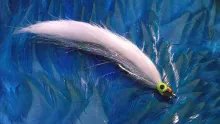
Bloody Butcher variation
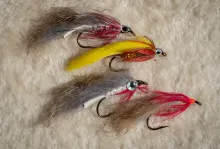
 Bloody Butcher variation 
Kasper Mühlbach
 
Back in 2003 I wanted to tie some silver bodied black zonkers for a trip to Bornholm. I didn't have any silver mylar tube for tying them, and it just had to be today.

I went through my box thinking "Mixed Synthetic Dubbing" and pulled out a bag of some kind of silver angel hair.

I cut the fibres into 1-2 cm of length (3/4"), mixed the fibres and put them in a dubbing loop. It worked well.

One of the advantages of this type of body is, that you can make your own color variations and make it grade from light to dark. You can also utilize the short fibres and trimmings, which you did not know what to do with.

Besides that, you can taper the body and make it more or less volumnious by trimming it after you have spun the hair or after you have turned the dubbing brush on the hook.

Here is a short guide and an example of a simple no-name fly.


About Angel Body Zonker
TypeStreamer
Originator
Kasper Mühlbach
Year of origin
2003
Tied by
Kasper Mühlbach
Difficulty
Medium
Target species
Smallmouth bass
Largemouth bass
Sea trout (sea run)

Materials
HookStreamer size 4-6
ThreadBlack
TailA few red feather barbules
BodyAngel hair spun in a dubbing loop (silver/gold/copper/optional)
WingZonker strip (black/olive/dark brown/optional)
Front hackleRed hen
HeadTying thread

Tying instructions
  1. Start the thread at the bend of the hook
  2. Tie in a few red barbules as a tail
  3. Prepare a narrow zonker strip
  4. Split the zonker strip right over the rear end of the body. Wetting it might ease the process
  5. Make sure its front end reaches the front end of the hook
  6. Tie the strip down with 10-20 tight turns of thread
  7. Leave it there for now
  8. Create a large dubbing loop
  9. Cut Angel Hair or a similarly fine flash material into 1-2 cm (3/4") long pieces
  10. Place in the loop and spin
  11. Wind to just behind the hook eye to form a body. Leave room for hackle and head
  12. Tie down and cut surplus dubbing loop
  13. You can trim the body now or when the fly is finished
  14. Pull the zonker strip tightly forwards, trim right in front of the body and tie down
  15. Tie in a hackle, stem first, curved side forwards, in front of the strip and wind it 2-3 turns forwards
  16. Tie it down and cut off the hackle surplus
  17. Create a head and whip finish
  18. Varnish the thread to the rear and the head
  19. Trim the body if not already done


Want to comment this page? Fill out the form below.
Comment
Only comments
in English
are accepted!
Your name Your email
Notify me on new comments to this article on the above email-address.
You don't have to comment to start or stop notifications.
We excuse for any errors or inconvenience caused by this service, which has new features still in an experimental state. In case of faults, please notify Martin at martin@globalflyfisher.com, and explain the problem, and we will try to fix it as soon as possible. Thanks for your patience

All comments will be screened by the GFF staff before publication.
No HTML, images, ads or links, please - we do not publish such comments...
And only English language comments will be published.
Name and email is optional but recommended.
The email will be shown in a disguised form in the final comment to protect you against spam
You can see other public comments on this page

 
Did you find the above interesting?
People who looked at the above also looked at:

Simple Streamers

Ray Bergman is the originator of these three simple mixed wing s...

GFF partner Bob Petti, USA

One of the GFF partners

S&L's Lost Flies

Dick Stewart and Bob Leeman's book "Trolling Flies for Trout and...

Staring Sunray Shadow

Ray Brook's classic the Sunray Shadow can hardly be outdone by a...

The new list of books

Our list of book reviews.
These other stories on "Fly Tying Materials - All the suff we use for our flies, feathers, hair, synthetics" might also interest you:

Hackle for streamers

raske streamers : One of the things most often asked by neophyte streamer tyers is what types of hackle are best suited for streamer wings. The short answer is.....there is no single source best suited for streamer wings. The long answer...well....I'll ramble on about it for the remainder of this essay! Go to the story

Stacking material

Even: When stacking materials it is important to consider it as consisting of more than just one process. There are several steps involved: material selection, cleaning and preparing, selecting the right tool and performing the stacking process itself. By Wayne Luallen Go to the story

More about Fly Tying Materials
A few random articles for your entertainment