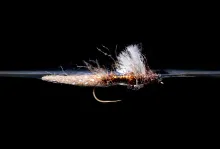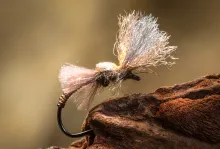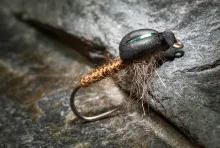
Fuffled Emerger

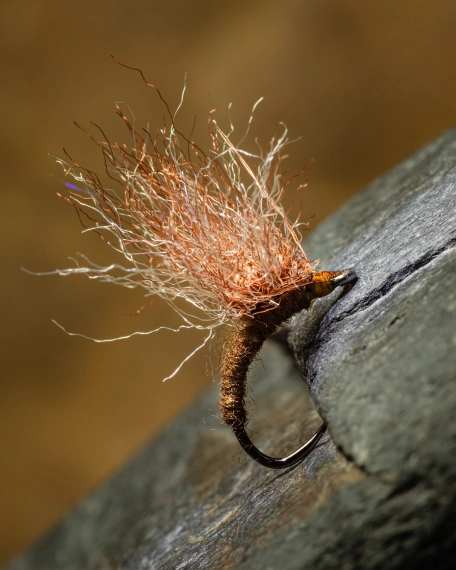
Fuffled is an old Scottish word meaning dishevelled, unruly, or mussed up. That’s a suitable adjective to use for this emerger.
No comments yetBy

Fuffled Emerger
Fuffled Emerger
Nick Thomas
Fuffled is an old Scottish word meaning dishevelled, unruly, or mussed up. That’s a pretty good description of an emerging insect in the process of trying to get all of its constituent parts out of its old nymph body. The process does not always go well, and the ensuing hiatus makes these unfortunates an attractive target for trout and other fish.

The Hackle Stacker, a style of fly developed by Bob Quigley in the late 1980’s, was designed to simulate the chaos of emergence. It is tied with a hackle wound up and down a post formed from yarn, thread or other material and then folded forward over the thorax of a fly. This puts all the hackle fibres on top of the hook simulating insect parts bursting out of the top of a nymphal wing case.

Wrapping the hackle up and down the post requires either a sprung gallows tool on your vice, or some considerable manual dexterity to hold the post in hackle pliers looped over the thumb of your thread hand. I don’t have a gallows tool and life is too short for faffing about with hackle pliers as a substitute for one. I also don’t use hackles anymore. They make me itch, are expensive, and in my opinion rather overrated as a way to float a fly. Consequently, apart from a few trial goes out of curiosity about the technique many years ago, I haven’t tied any flies using the method. Then I had an idea for a way to achieve the stacked effect without having to do it in-situ on the fly.
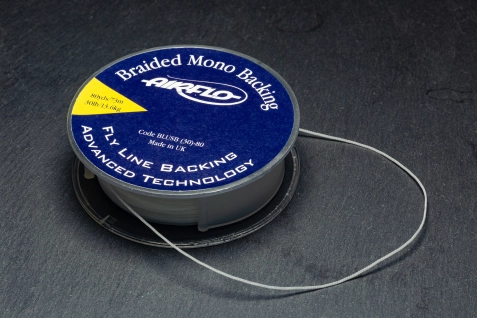
Hollow braid
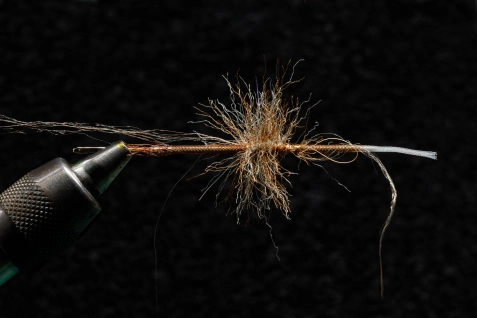
The completed Fuffled fibre brush
The braided line and the completed Fuffled fibre brush
Nick Thomas

I’ve used hollow braid fly line backing as the foundation for tying detached fly bodies on many of my designs. The technique is pretty simple with the braid on a needle clamped in a tying vice. Tying thread is run on over the braid, a material of choice, such as latex, organza ribbon or anything else that comes in a narrow strip, is tied in and then wrapped over the braid. Once the thread has been whip finished the body is slid off the needle ready to attach to a hook.

One day it occurred to me that if I used a dubbing loop of polypropylene fibres wrapped over the braid, I would have a flexible pseudo-hackle brush that could be tied onto a fly and folded forward to achieve the look of hackle stacker. I use a 0.9mm/size 90 sewing needle which has a snug fit inside the hollow braid without unfurling the ends as you push it through the braid.
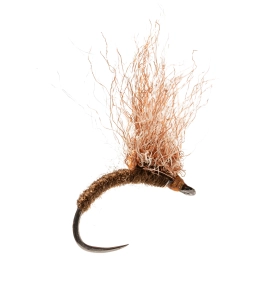
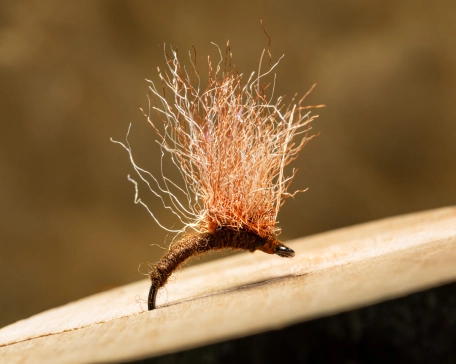
Fuffled Emerger
Fuffled Emerger
Nick Thomas

Fuffled Emerger

Fly pattern, materials and tying steps

Nick Thomas
brown trout
grayling
Materials
Hook Fasna F-120 #12-16
Thread Semperfli 18/0 nano silk
Body Acrylic darning yarn
Wing Fulling Mill Salty Fibres
  1. Colour a length of braid with a marker pen, insert a needle and clamp in your vice.
  2. Run on the thread and wrap towards the vice, whip finish leaving a long tag end.
  3. Form a dubbing loop and insert some chopped poly-yarn fibres. Spin the loop and brush out the fibres.
  4. Wind the loop over the braid to create a brush of the desired length.
  5. Tie in the loop, cut the loop at the dubbing spinner and pull out any remaining fibres.
  6. Whip finish the tying thread and cut the tying thread and dubbing loop threads leaving long ends.
  7. Slide the body off the needle and pull on the whip finished thread at both ends to tighten the thread onto the braid.
  8. Once you’ve made the Fuffled brush, the rest is straightforward.
  9. Run the thread on at the hook eye, take around the bend and back.
  10. Catch in a piece of darning yarn and tie down around the bend.
  11. Bring the thread forward and tie in the prepared fibre brush against the end of the brush securing the tag end(s) of thread with the brush handing back over the hook. Cut off the thread tag(s).
  12. Wrap the yarn up the hook to the back of the brush and then past it up to just before the hook eye. Tie in and remove the waste end.
  13. Fold the brush forward, tie in the braid and the thread tag(s).
  14. Cut off the waste ends, tidy up the head, whip finish and varnish.
Easy

Fuffled Emerger
Fuffled Emerger
Nick Thomas
I regard the Fuffled technique as one that can be adopted and adapted as the basis of a wide range of emerger patterns. I like mine on curved hooks like the one shown here, tied on size 12 hooks for lakes and sizes 14 and 16 for rivers and streams. However, if you prefer a straight hook, maybe with a trailing shuck, then go for it.

Oh, and if you do prefer hackles for floatation, you could use the Fuffled method for a hackle stacker. I haven’t tried it, but I can’t see why it would not work and it’s more straightforward then the traditional method.

Image gallery for Fuffled Emerger

Since you got this far …

A money box
The GFF money box

… I have a small favor to ask.

Long story short

Support the Global FlyFisher through several different channels, including PayPal.

Long story longer

The Global FlyFisher has been online since the mid-90's and has been free to access for everybody since day one – and will stay free for as long as I run it.
But that doesn't mean that it's free to run.
It costs money to drive a large site like this.
See more details about what you can do to help in this blog post.