
For many saltwater anglers the term "worm hatch" has a magical ring to it. When the worms spawn, the fish usually go berserk, be it trout, stripers or tarpon. As one writer puts it: It's like yelling "free lunch" to a high school football team.


The clam worms or rag worms (Latin: Nereididae or formerly Nereidae) are stable food for our Scandinavian sea trout in the spring, and for many saltwater anglers the term "worm hatch" has a magical ring to it. When the polychaete worms swim freely to spawn, the fish usually go berserk, be it trout, stripers, tarpon or a number of other species. As one writer puts it: It's like yelling "free lunch" to a high school football team.
The worms usually live in or near the bottom, but during a short period, typically in the early spring and in connection with a certain moon phase, the worms will rise from the bottom and swim freely in the water.
The amount of food in the water makes fish as well as birds start feeding frantically. You see birds hovering over the water and diving for the worms, which can be found in the thousands. As anglers we see the worms in the water in large numbers, which is normally quite uncommon.
And the fish of course dive into this orgy with very little reluctance. So for these few days every year where the worms are prolific, we need a worm pattern.
I have seen lots of these patterns in my time, most of them large and complex like "The Real Borsteorm", the MOAL or a large number of more or less innovative, but always very complex patterns, spotted at fly tying shows or in fly shops.
Most of these are far too cumbersome to tie for my taste, and having them in the box for the once every second-or-third-year occasion that I need them, feels like a waste of flybox space and tying time.
For many saltwater anglers the term "worm hatch" has a magical ring to it


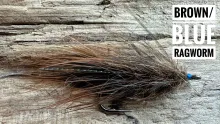
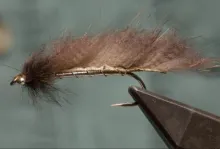
My personal best clam worm imitation has been a simple, long winged zonker. I tied a handful a couple of years ago using a black cone head, a plain black rabbit zonker strip and was tied on a heavy black hook.
That particular fly forms the base for this Mundane Clam Worm. I originally used the black Tiemco TMC 700 hook, but you can change the hook to the Mundane Fly Project's Kamasan B175 or any short shank saltwater hook, which is easier to find. The black or blue cone can be replaced by an easier accessible brass bead or cone. Dye it black or any color with a marker, or varnish it in the color you desire. The fur can be any zonker strip. Rabbit is very common and easy to find, but I just got hold of some really long haired Eumer zonker strips cut from Finn Racoon, and that only makes the worm longer and more mobile. The commonly available rabbit will do just fine.

This pattern is a part of The Mundane Fly Project, which aims to create really simple patterns with few common materials.
There will be more on the project as more patterns get published.
- Log in to post comments





Dear Martin,
here i
Dear Martin,
here in UK, we tie the exact fly , very , very simply. We refer to it as "The Leech". With incredible results for Trout.
Alexander, The zo
Alexander,
The zonker strips I used were very common rabbit zonker strips. I bought them precut (I usually cut my own) and the width and hair lengths was perfect for this purpose. I even have the empty package in front of me as I write this, and even though it has no brand name, It comes from Danish The Fly Company where it's listed as catalog number "0049-03 - 3mm S-cut Black Rabbit".
But it's nothing special and very much like any rabbit zonker strips you'd be able to find in almost any flyshop.
Martin
Hello Martin,
I hav
Hello Martin,
I have a problem with the fur that is needed for the Zonker. I have Racoon and Foxtails. The hair is as long as my small fingers. Such Zonkers made wet, look like a Banana and not as thin as the Zonkers of your ZonkerWorm. Did you cut the hair short? Or what is the secret of its thinness?
Thanks for a good idea
Alexander
Freiberg
hi to all simple and
hi to all simple and easy tiers.
I made my first dry and wet flies with nothing but a hook a thread and a feather( 1980). so called bottle brush flies Dry flies I optimized with a cigarette letting the feather be twisted a bit. This increase the contact on the water. Then I saw an article in a fishing paper. For flies only a hook was needed and some monafilement. Nothing else. The fishing line was used to build up the body, the legs and the wings. The knods were used and integrated to shape the fly. All I remember is that such flies were made and used long ago in Spain. Does anyone of you knows anything of such flies?
Alexander
Freiberg
Ralph,
As most on
Ralph,
As most on zonkers, the tail can wrap around the hook, but I haven't found it to be a massive problem, and even with the fairly long tail it works fine for me. It happens, but I check the fly regularly and untangle it if there's trouble.
As usual when fishing heavier flies and stuff that can tangle, I can recommend a slower casting stroke. That keeps things from tangling quite as much as the wildly energetic double hauls that people seem to love these days - at least on our coasts.
Martin
Martin, very nice an
Martin, very nice and easy fly. I like it.
Btw: Very good idea with The Mundane Fly Project. I am looking forward to see next flies.
Hello!
A very simpl
Hello!
A very simple and versatile fly as I like it most, being more a fisher than a tyer.
But doesn't it have the drawback of fouling much too often?!?
Ralph Hertling
Berlin