GFF logo


First published February 28th 2006 - More than 3 years ago

La Muerte

A simple, generic and light fly for tarpon

By Martin Joergensen

  
Image file
missing here

 La Muerte 
Martin Joergensen
Los Campiones
 Los Campiones 
Claus Paludan
 
During my most recent tarpon trip to Mexico I had little luck with the large members of the species. I caught plenty babies, but no biggies.

Opposite Lars Mathiessen. Lars had good luck... ehr... showed excellent skill with the big ones and was by far the angler in the company who hooked and landed most large tarpon in the open ocean. He also did fine on the babies, but with the big fish in the ocean he severely outfished the rest of us.

Now it might have been luck. It might also have been a good guide. It is more likely to have been skill. And it might have been the fly. A combination is probably the right answer.

What I can supply
Now I can't supply the luck.
The guide—Carlos—is still in Rio Lagartos and you'll have to go there to get him.
The skill... well, you'll have to hone that yourself.
But the fly pattern, that's something I can help with. First of all because Lars was very open about the fly and opened his box to us during our afternoon rhum-on-the-porch sessions, and secondly because it's a fairly simple and generic pattern.

I have baptised the fly La Muerte because I nicknamed Lars "El Muerte" during our stay. Since the gramatically correct way to say this is "La Muerte", this is now my name for the fly. Lars earned this honorable name because he rubbed a very dense, white sunscreen on his skin every day, which left him looking quite ghost-like.

The fly is a variation of the classical splayed feather-tail tarpon fly as found in many patterns devised by many different tiers. Splayed tail, a couple of hackles and a long snout. Much like the Splayed Alive Pike Fly actually.

The tying instructions are uncomplicated and most people would easily be able to fill their boxes with this pattern. Lars used nothing else, so you can trust that it works. He had luck with the blue and white flies, but also had some red and white ones in his box.

La Muerte


About La Muerte
TypeWarm salt water
Originator
Lars Mathiessen
Year of origin
2004
Difficulty
Easy
Target species
Tarpon

Materials
HookLarge Owner saltwater hook, 1/0-5/0
ThreadYellow or white
TailA few straws of flash, four soft, white hackle feathers, two soft, blue hackle feathers
HackleSoft, blue hackle feather and a soft, white hackle feather
HeadTying thread
EyesDoll eyes
HookDry, long, size 10-16
ThreadColor o match body.
BodyPoly yarn cut into 1 cm pieces.
WingPoly yarn

Tying instructions
  1. Start the tying thread at the hook bend
  2. Tie in a few straws of flash extending rearwards
  3. Select four large white hackles
  4. Strip off the barbs on the stem of the feathers. Aim for a length about 4-6 times hook shank length
  5. Tie in two white feathers and one blue on each side of the hook
  6. The feathers must sit vertically curving out and to the very rear of the hook
  7. Prepare two hackles, one blue and one white
  8. Tie in the blue one first and wind it forwards followed by the white one
  9. Create a long, tapered head on the front part of the hook
  10. Stick two doll's eyes to the rear part of the head
  11. Varnish or epoxy the head over the thread and eyes

Materials
HookLarge Owner saltwater hook, 1/0-5/0
ThreadYellow or white
TailA few straws of flash, four soft, white hackle feathers, two soft, blue hackle feathers
HackleSoft, blue hackle feather and a soft, white hackle feather
HeadTying thread
EyesDoll eyes
HookDry, long, size 10-16
ThreadColor o match body.
BodyPoly yarn cut into 1 cm pieces.
WingPoly yarn


Tying instructions
  1. Start the tying thread at the hook bend
  2. Tie in a few straws of flash extending rearwards
  3. Select four large white hackles
  4. Strip off the barbs on the stem of the feathers. Aim for a length about 4-6 times hook shank length
  5. Tie in two white feathers and one blue on each side of the hook
  6. The feathers must sit vertically curving out and to the very rear of the hook
  7. Prepare two hackles, one blue and one white
  8. Tie in the blue one first and wind it forwards followed by the white one
  9. Create a long, tapered head on the front part of the hook
  10. Stick two doll's eyes to the rear part of the head
  11. Varnish or epoxy the head over the thread and eyes

As the originator Lars Mathiessen notes in his mail to me about the fly: "Finish the fly with good sprinkle of luck. You will need that if you want to catch a tarpon - even with this fly"


Want to comment this page? Fill out the form below.
Comment
Only comments
in English
are accepted!
Your name Your email

All comments will be screened by the GFF staff before publication.
No HTML, images or links, please - we do not publish such comments...
And only English language comments will be published.
Name and email is optional but recommended.
The email will be shown in a disguised form in the final comment to protect you against spam
You can see other public comments on this page

If you want to submit a private comment, not for publication, use this form

 
Did you find the above interesting?
This other story related to "tropical" might also interest you:

Rising Tide

Bonefishing theme: "What you got?"
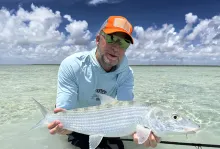
"It’s a small one"
The fish is fought to the boat and assessed.
"Eight-pound fish. And this fish is a minnow compared to those fish that we were casting at out there..." The review of Jamie Howard's DVD can be found here

Click to see other stories with the keyword "tropical"

A few random articles for your entertainment

A Global Fly Fisher Publication
Copyright © 1994 - 2008, Joergensen/Petti/Schweitzer/Skehan
Portions of this site copyright © the contributors. All rights reserved.
This material is for personal use only. Do not distribute without prior written consent from each copyright holder.
Comments and suggestions are welcome