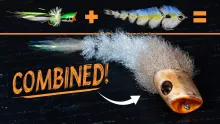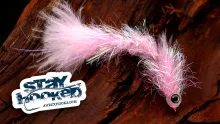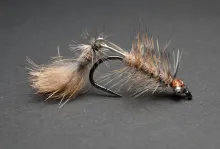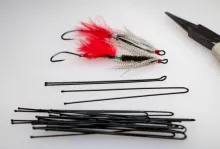
The flies on this page all have one thing in common: they have a linked body. Many of us strive to add life to our flies - the sense of something living. This can be done by using soft materials or adding long tails like on zonkers. These are all fine techniques that work well. But something urged me to try something different.


Movement and life
The flies on this page all have one thing in common: they have a linked body. Many of us strive to add life to our flies - the sense of something living. This can be done by using soft materials or adding long tails like on zonkers.

These are all fine techniques that work well. But something urged me to try something different. We've all seen flies that use two hooks, often linked by a piece of monofilament. I tied a few of this type, but I'm not very fond of these flies. First of all I don't like two hooks on a fly. The rear one might fail or they may both hook the fish. These flies also get heavy and quite large.
The first ones
My first linked flies were heavy too. I wanted to add a short shaft behind the hook. This could be used to add a longer body or as foundation for a tail. The shaft should be linked to the hook, not just attached by a stiff piece of mono. I tried bending all kinds of hinges and eyes and tied them on the hook. I also used hook shafts without points as it has been seen before.
I ended up using a thin stainless wire for the shaft and a loop of mono for the link. This works fine and adds little weight.
   |    |
- Log in to post comments