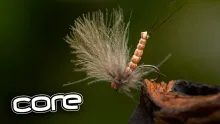
When Czech Luboš Roza – many times World and European champion in fly fishing – chooses flies, it’s worth paying attention
The Czech angler Luboš Roza has seven World Championships and two European Championship titles in fly fishing under his belt – both individually and as part of a team. When he and his friends choose flies, it’s wise to pay attention.
His teammate Igor Slavik first tied this fly in the mid-1990s. A good fly deserves a good name, so he asked his wife Sabina – Sabka to those close to her.
“It looks like Tina Turner,” she replied. “Call it Rockerka!”
Rockerka means female rock artist in Czech.


The originator of Rockerka is Igor Slavik, but his close friend and teammate Luboš Roza deserves much of the credit for making it well known. It’s licensed to Fulling Mill as Roza’s Rockerka and is now sold under various names.
Truly good flies are often copied.
Rockerka is Luboš Roza’s very best dry fly. It has contributed greatly to his many championship wins. He trusts it to work everywhere, every time and on all kinds of fish. It can be fished with active retrieves, as a dropper (a dry fly on the surface acting as an indicator for a nymph below), or dead drift, especially in smaller sizes.
Truly good flies are often copied.
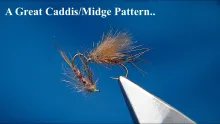
Another dry fly Luboš recommends is Grey Mouse. It has everything we know fish like, is as versatile as it's simple, and consists only of hook, thread, and CDC feathers – even for the tails. For Luboš, it's among the most versatile dry fly patterns when fish are selective. Like Rockerka, it’s tied with red thread that creates a visible “hot spot” at the head.
Rockerka dubbing loop

Form a loop with the tying thread and insert the loop into the dubbing spinner. Place about four – the number depends on hook size – large CDC feathers on top of each other. Fold them using a Petitjean Magic Tool or similar. Transfer them to a clip. Cut away the feather stems, and place the feather fibers into the dubbing loop.
How far the base stubs of the feather fibers protrude from the dubbing loop determines how thick the “body” of the fly will be – the tips of the fibers will stick out. The length of the base stubs should be adjusted to the hook size.
The loop is spun and wrapped by stroking the fibers well backward as they are wrapped. Feather fibers that are too long are preferably trimmed by pulling them off rather than cutting them.


Especially with CDC dry flies, treatment and cleanliness is important so they keep floating high, are visible and fish optimally.
This is particularly important when CDC feathers have lost their natural oil from the bird’s gland during dyeing. Because of that, many anglers treat the feathers before use. Luboš uses Blue Ribbon powder.
During use, it's especially important to wash and dry off fish slime. If this is not done with CDC flies, they quickly become useless.
A drying trick that has taken the fly-fishing world by storm is attaching a rubber band to your vest, hooking the bend of the hook into it, tightening, and then playing it like a guitar string a few times.
Recently a commercial product called The Fly Banjo made of silicone was launched.
The trick works on all dry flies and is more effective than false casting.
There's a video showing how to tie the fly here: Luboš Roza's Rockerka.
- Log in to post comments