
The C&F extended tube body tool is more than two darning needles in a fancy holder. If you - like Dutch Henk Verhaar - like doing it yourself, this might be worth looking into. The flies tied with extended bodies can become very realistic and still be simple to tie.
C&F site.
A couple of years ago, Christian Billard introduced his readymade, lifelike hollow extended fly bodies, aptly named Tube Bodiz (he is a Frenchman, after all) to the world.
Besides using them as 'ordinary' extended bodies, he also introduced innovative patterns, like his Area 51, that made the most of his Tube Bodiz.
There are currently several manufacturers selling these or similar readymade extended bodies under sometimes very similar names. Czech Siman and also French Bidoz are two well known suppliers.

Mayfly |

Caddis |
As I am quite partial to do-it-yourself, and therefore no big fan of readymade tying materials, I never bought any of these products - just like I only started using dubbing brushes after acquiring a (or actually several) contraptions to make these brushes myself.
On occasions I would see fellow demonstration tiers make such bodies, using makeshift tools and elaborate procedures. To me, it looked like more trouble than it was worth, and so I forewent this style of extended bodies, using clumps of deer hair, braided marabou, or furled wool and dubbing loops instead.

The tip |

Starting off |

Tails |

Glueing |

Almost done |
However, since I am a big fan of extended body flies and was still tempted by the lifelike qualities of these body tubes, I was pleasantly surprised to find that C&F, of tool and gadget fame, have recently introduced a tool that makes producing this type of extended bodies at home painless enough to actually take it up. So I bought one (or actually several) and started churning out body tubes by the dozen.
The C&F tool basically is nothing more than a darning needle - just like the makeshift tools I had seen others use. However, what sets it apart from other darning needles are three things:
one - the base of the darning needle is equipped with a small secondary needle, to trap and lock the first wraps of the base material.
two - it comes with its own adaptor to put the tool in a vice, so that additional manipulations can be performed on the body tube with both hands, such as adding a rib.
and three - it has a thick and a medium needle, one on either side of the tool, so that you can make several sizes of body tubes.
A fourth feature - a bottle with a specially formulated cement, actually a kind of acryllatex adhesive, to impregnate the bodies, I quickly put aside, since I found that flexament yields better bodies; plus the bottle is shaped such that you easily tip it, effectively coating your tying station and floor boards with the stuff...
So how does this tool work?
Well, basically you wrap dubbing around the needle, using the small auxiliary needle to lock the dubbing in place, going from thick end to tip and back again. When finished wrapping, you lock the dubbing material in place by rotating the tool between your fingers, tightening the wraps, and then soaking it with flexament or a similar flexible adhesive.
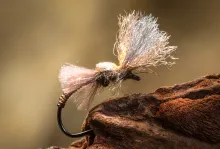
Then completed body can then be pushed off the needle, using your thumb and index finger nails. After drying, the body tube is ready to be attached to a hook and converted into a fly (see sequence).
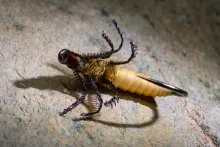
The nice thing about making body tubes yourself is that you can add all kinds of embellishments, a.k.a. realistic additions, such as segmentation ribs, mayfly tails, trailing shucks, dragonfly nymph gills, or mayfly nymph side filaments, using moose mane hairs, marabou, ostrich, antron, you name it (see picture).
What's more, since you're making the tubes, you can integrate these additions in the body itself, like wrapping the tails into the body (see sequence), or attaching the ostrich filaments' while ribbing. Ribbing by the way is preferably done when the flexament is still wet; this is were the vice adapter comes in handy. I've also found that since I wrap the ribbing tip to base, front to back (see picture), it is best to wrap the dubbing material back to front, i.e. counterclockwise when seen from tip to base of the needle.
One thing to keep in mind is that not all dubbing materials are suited for this technique. You'll want a long-staple material with lots of 'cling', which usually means underfur from large animals, with lots of long fuzz. Rabbit, hare, or small rodents don't work worth a dime. Arctic fox and similar stuff can be used, if handled carefully. My favourites though are camel dry fly dubbing and good old sheep's fleece; these materials can be roped and wrapped around the needle without even looking, so much 'cling' do they possess. Musk ox underfur may also work, although it is hard to come by and comes in one colour only...
So is this tools worth its money? As all C&F tools, it is quite, even overly, expensive, at approximately €38.- (Approx. US$ 35.-)retail. However, this is one C&F gadget that I would not want to be without ever again (and hey, you don't have to tell me I am a gadget freak...)

No. 1 Tubos |

Micro bodies |

Damsel nymph |
- Log in to post comments



Of course its a nice
Of course its a nice gadget, but a needle and a wooden handle is all you need.
Recommendations: use ''silk-dub'' as dubbing material and ''colle photo'' as glue.
My dear friends,
It
My dear friends,
It wasn't necessary to buy this kind of tools, you only needed an ordinary needle.
The results are simply the same.
Found it ! mikestack
Found it ! mikestackleshop.com has a great selection on all C&F Stuff
Looked all over the
Looked all over the net, can't find a place that sells it in the US. "help"
Is this tool for sal
Is this tool for sale ANYWHERE?!? I cannot even find it on the internet -- even the C&F website has dropped it. What's up?
Where did you purcha
Where did you purchase your C&F tool?
Very good write up.
Good service
Good service