
This in one of several articles in a series being created as a group effort by members of the Streamer List to provide some background information on the species of forage fish we most commonly try to immitate with streamer patterns.
- Introduction:
- Black Nose Dace (Rhinichthys atratulus)
- Bibliography
- Pattern Listing
- Thunder Creek Blacknose Dace (Kieth Fulsher)
- Art Flick's Bucktail
- Blacknose Dace (Bob Zwirz and Kani Evan)
- Beady Eye BND
- Matuka Blacknose Dace (Dave Whitlock)
- Male Dace
- Golden Darter (Lew Oatman)
- Marty's Dace
- Scraggly Lake Dace
- Blacknose Dace Clouser Minnow
- Disco Dace - EZ Blacknose Dace
- Disco Dace - Surf Candy Blacknose Dace
- Disco Dace - Blonde Blacknose Dace
- New Age Dace
- Simple Dace
- Simple Dace 2
- Simple Dace 3

Title Illustration By Doug Saball
Introduction:
This feature is a the first of a series of articles being created as a group effort by members of the Streamer List to provide some background information on the species of forage fish we most commonly try to immitate with streamer patterns. Many thanks to Lindsey Grandison for coordinating this effort, as well as the list members who contributed patterns and other information!
Black Nose Dace (Rhinichthys atratulus)
This description of the Black Nose Dace was submitted by Doug Saball with added notes by Will Taylor
This small minnow, about 2 1/2 inches, may be distinguished from other minnows by the black lateral band which extends around the snout backward through the eye to the tail. The body is plumply rounded in front and compressed behind. The back is olive-green to dark brown in color while the lower sides and belly are silvery-white. Scattered over the back and sides are darkened scales. In breeding season males, have a rust-red coloration on the lower sides, and some have orange or red coloration on the pectoral fins.
This species is distributed from the Northern Atlantic coast near Nova Scotia west through the Great lakes region to Manitoba, and the Dakotas and southward on both sides of the Appalatian Mountains to Virginia, Georgia, Alabama, and Mississippi. It is reported to be found occasionally in brackish water in the Maramichi river tributaries before the head of tide (2). Two subspecies, R.a. atratulus, in n. and cen. Atlantic Slope drainages(including James and Roanoke rivers) and e. Great Lakes-St. Lawrence basin(west to e. Lake Ontario), has silver-white to gold-yellow along and below black-red stripe on the side of the breeding male. R.a. meleagris, over the rest of the range but apparently also inhabiting James and Roanoke drainages, has orange to brick red stripe along and below black stripe on the side of the breeding male. There is a distribution map (#108, in Peterson's Field Guide to Freshwater Fishes p. 100). There are good color illustrations of the breeding males of both of these subspecies as well, on plate 16 (but no illustrations of nonbreeding colors).
This fish is often a curiosity to fishermen because it often has numerous black spots or bumps covering its body and fins. These spots are from the encysted stage of a larval parasitic worm which is found beneath the fish's skin.(1)
The black nose dace is found in small, rapid streams with rocky or gravely bottoms. Occasionally it is found in large rivers, but seldom in lakes and ponds. Commonly the black nose dace is found in the company of brook trout as well as some streams with temperatures above that which brookies can tolerate (1).
The Black nose dace spawns when the temperature reaches about 70 degrees, usually in May or June (2). Spawning takes place over gravel bottoms in the fast water of shallow riffles, where the water is a few inches to a foot deep. There are 4 sub species that have differing methods of nesting which range from building a small pebble nest to no nest at all. Some sub-species develop a territorial behavior, especially the males. Other sub-species abandon the nest after fertilization. It is reported that black nose dace are 25-61 mm the first year in Ohio. In Michigan the populations matured at 2 years. It is suspected that this species is short lived living only 3 or at most 4 years (2).
The food of the black nose dace consists primarily of aquatic chironomids insect larvae, and diatoms. Desmeds and other phytoplankton were eaten during November through March. They will also eat their own eggs, or others eggs if given the opportunity. In turn the black nose dace is eaten by larger brook trout and fish eating birds such as mergansers and loons (2).
Common names are blacknosed dace, black-nose dace, eastern blacknose dace, dace, striped or redfin dace, brook minnow, pottlebelly, and potbelly (2).
Bibliography
- Freshwater Fishes of New Hampshire, John F. Scarols, New Hampshire Fish and Game Department, Division of Inland and Marine Fisheries, 1973.
- Freshwater Fishes of Canada, Bulletin 184, Scott, W.B., E.J. Crossman, Fisheries Research Board of Canada, Ottawa 1973.
- Peterson's Guide to Freshwater Fish. Page and Burr
Pattern Listing
Thunder Creek Blacknose Dace (Kieth Fulsher)
Lindsey Grandison

| HOOK COVERING | embossed silver tinsel |
| LATERAL STRIPE | black bucktail |
| TOP OF HEAD AND BACK | brown bucktail |
| BOTTOM OF HEAD AND BELLY | white bucktail |
| EYE | Yellow lacquer with black dot |
| COMMENTS | Draw a black line on the head from the hook eye to the rear of the head |
Lindsey's Comments
Detailed tying instructions for this and all the Thunder Creek patterns are given in the Thunder Creek page.
Art Flick's Bucktail
Submitted by Lindsey Grandison

| HOOK | size 4-10 |
| THREAD | black |
| TAG/TAIL | red yarn, very short |
| BODY | silver tinsel |
| THROAT | cream or light ginger |
| WING | white bucktail (original called for polar bear) over which is tied Black bear hair (or black hair from a shunk tail or black bucktail)shorter in length than other wing material, over which is tied Brown bucktail |
| COMMENTS | This early pattern was originated and popularized by Art Flick in his widely read books (Streamside Guide to Naturals and their Imitations, 1947; New Streamside Guide, 1969). It remains one of the most widely described patterns for Blacknose Dace and typically is the pattern available in flyshops and mail order catalogues. |
Blacknose Dace (Bob Zwirz and Kani Evan)
Submitted by Lindsey Grandison

| HOOK | size 2-8, 4 X L |
| THREAD | white silk thread size 000 |
| HEAD | top - brown, bottom - white |
| TAIL | cream or light ginger |
| BODY | antique white, spun fur. Tapered full to head, picked out with dubbing needle and stroked back. |
| THROAT | cream or light ginger |
| WING | two white marabou over which are Two light drab (olive toward brown tone) marabou feathers |
| MYLAR | Silver, upper third painted black, the paint extends from the tip to painted eyes. |
| EYES | large white, black pupil, coated with clear lacquer |
Lindsey's Comments
This is one pattern from Bob Zwirz and Kani Evan's Miracle Marabou Streamers series. Bob Zwirz introduced this pattern in a 1963 article in Field and Stream. Abstracted from Joe Bates' 'Streamer Flytying and Fishing'.
Beady Eye BND
Submitted by Lindsey Grandison";

| HOOK | size 4-10, 6 X L, straight eye |
| THREAD | black, wrapped along the shank to represent the lateral line |
| TAIL | light tan synthetic hair |
| EYE | split brass bead painted with a black pupil |
| BODY | silver mylar tubing pulled back top and bottom and tied off |
| THROAT | white synthetic hair |
| WING | tan over which is very sparse dark brown synthetic hair |
| GILLS | floursecent red thread; epoxy head and gill area. |
| COMMENTS | This pattern was described in Dick Stewart and Farrow Allen's "Flies for Trout" |
Matuka Blacknose Dace (Dave Whitlock)
Sunmitted by Bob Petti";

| HOOK | streamer hook (display fly is tied on a Partridge Bartleet hook) |
| THREAD | Black |
| TAG | Flat Silver Tinsel |
| BODY | creamish sparkle dubbing |
| RIBBING | fine oval silver tinsel |
| WING | a pair of light furnace hackles, tied Matuka style |
| THROAT | red hackle base fluff |
| CHEEKS | Bobwhite quail wing covert (soft hackle feather) |
| EYES | small plastic dolls eyes glued on cheek |
Bob's Comments
Notes: The pattern as submitted was tied to match a fly shown in the Fly and Field mail order catalog. The choice of a Bartleet style hook for a streamer is an odd one, but I have no doubt that the fly will ride nicely in the water. Looking back after tying the fly I would have used two pair of hackles instead of the single pair to make the upper portion of the wing more visible. The original pattern called for mallard breast or ringneck pheasant feather for a cheek, but they were too large for the hook size choosen to match a blacknose dace's overall body length. I substituted a rich brown mottled bobwhite quail wing covert feather. The body dubbing was a blend of cream rabbit fur, white sparkle yarn, and light tan sparkle yarn
Male Dace
Submitted by Bob Petti

| HOOK | TMC 300, #6 |
| THREAD | Black Danville 6/0, White Danville Flat Waxed Nylon |
| BODY | Cream Floss |
| RIB | Flat Gold tinsel |
| THROAT | Orange Hen |
| WING | A pair of olive hackles inside of a pair of golden badger hackles |
| CHEEKS | Jungle Cock |
| HEAD | Black |
Golden Darter (Lew Oatman)
Submitted by Bob Petti

| HOOK | 6x long, sizes 6-10 (display pattern is tied on a size 6 TMC 300) |
| HEAD | Black |
| TAIL | a small section of mottled turkey wing quill, no longer than gap of hook. |
| BODY | yellow floss, slightly tapered. |
| RIBBING | medium narrow Flat Gold Tinsel |
| WING | Two golden edged badger saddles, extending slightly beyond tail |
| CHEEKS | Jungle Cock, fairly short, pointed downward. |
Bob's Comments
Notes: The display fly is not a true Oatman pattern, as the tail has been omitted, the body lacks an obvious taper, and the wing is composed of a light furnace hackle rather than golden edged badger (which is quite difficult to find). However, as a fishing fly it serves the purpose well.
Lew Oatman tied this pattern sparsely for used as a blacknose dace
imitation (cf. Bates' Streamer Fly Tying and Fishing, 1950).
Marty's Dace
Submitted By Aaron Hirschhorn

| HOOK | 2XL Nymph |
| THREAD | Black 8/0 |
| BODY | Bill's Bodi-Braid |
| WING | Monga Ringtail and Red Squirrel or similarly colored Craft Fur (brown shade) |
| EYES | Yellow with black pupil |
Aaron's Comments and Tying Instructions
The fly is called Marty's Dace because I got it from my friend Marty. He had no name for it.
- Insert hook in vise.
- Attach thread at eye and wind back several turns (1/8- 1/4")
- Hd Bodi-Braid along the side of the hook and wind thread back to bend of hook.
- Run thread back to the point where you started to wind on the braid.
- Wrap braid forward in touching turns (not overlapping) to tie off point.
- Attach wing - white, black and then brown in ascending order.
- Finish head, cement and put on or paint on eyes.
Scraggly Lake Dace
Submitted by Will Taylor

| THREAD | Black 6/0 |
| HOOK | 6XL streamer hook, sizes 10-4 (example on Mustad 3665A, size 4) |
| TAIL | short red wool |
| BODY | flat silver tinsel down & back |
| RIBBING | fine oval silver tinsel |
| THROAT | white bucktail, length of wing, next to hook |
| WING | 8 strands yellow crystal flash next to hook; then two black saddle hackles, tied flat; then a mallard flank feather, dyed chocolate brown(I dyed these myself), tied flat |
| HEAD | cement with penetrating head cement, finish with Loon Outdoors Black Hard Head Fly Finish |
| EYES (OPTIONAL) | painted on head, white with black pupil |
Will's Comments
Inspired by blacknose dace in breeding coloration netted by my son during a trip two summers ago to (northern) Scraggly Lake, near Patten, Maine. I originally tied this with a black bucktail underwing, but find that the black saddle hackles create a better lateral stripe. I've grown to like these flatwing flies, though have not tied many. They present a realistic slim profile for such forage fish as smelts and dace. The mallard flank feathers have wonderful action underwater, and the flat wing alternately lifts and slims back on a stripped retrieve, alternately displaying and concealing the underlying flash in a minnow-like way.
Blacknose Dace Clouser Minnow
Submitted by Will Taylor

| THREAD | pale yellow Flymaster 6/0(this thread is translucent, and becomes nearly transparent when saturated with a penetrating head cement, allowing the underlying wing material colors to come through when finished) |
| HOOK | Tiemco TMC 5263 (3XL nymph/streamer hook, model perfect bend, down-eye); size 10 thru 6 (example tied on a sz.6). |
| BODY | none |
| EYES | Painted non-toxic eyes (steel dumbell; Raymond C. Rumpf & Son, P.O. Box 319, Sellersville PA 18960; also available from Umpqua & Orvis). Size 4/32; pearl or yellow with black pupil. I stay away from lead - I'd miss the loons. A heavier fly can be made by going up one size (to 5/32 or even 6/32); a lighter, slower-sinking fly can be made by using hollow bead-chain eyes, which are still sufficient to turn the fly over to fish inverted, and can be painted. |
| BELLY | sparse white bucktail (fine, well-kinked), slightly shorter than wing length; do not stack |
| UNDERWING | 4-8 strands pearl crystal flash; then sparse yellow Icelandic sheeps wool, 2/3 length of wing |
| GILLS (OPTIONAL) | very sparse red antron dubbing tied very short just above the underwing |
| WING | very sparse black bucktail (fine, with less kink; stacked to even tips); then sparse chocolate brown bucktail (fine, well-kinked; not stacked) |
| HEAD | single layer of thread over wing materials, then clear fingernail polish thinned to penetrate |
Will's Comments and Tying Instructions
Length of finished fly, 2 to 3 inches. I usually tie this for smallmouth, in the larger sizes (we have fabulous smallmouth fishing in the lower Penobscot River & the lakes of downeast Maine).
Mount hook upright in vice. Start thread 1/4 shank length back from eye and build a small bead with several wraps. Move back and build a similar bead to leave a "saddle" for the eyes. Mount the eyes on top the hook and bind with several figure-8 wraps, then several square lashing wraps (over one side of eye, under hook behind eyes, over other side of eye, under hook ahead of eyes, etc.); then several "fraps" (circular wraps around the square lashings - under eye, over hook, under eye, over hook, etc.) to tighten everything up. Finish with 2 half-hitches. Glue these wraps with a drop of zap-a-gap or flex-gap gap-filling super glue and allow to dry (try not to become one with your fly at this stage).
With hook still upright, tie in the belly; make this just a tad shorter than the desired wing length. Don't stack the white bucktail - the naturally staggered tips help give the fly its shape. I prefer for the belly and brown wing to use fine hair with good kink - this makes a more ragged-looking fly, but one that has more transluscency and better action in the water. Tie bucktail in in front of eyes, then cross under hook to behind eyes and wrap gently back (so as not to flare the hair) for 5-6 wraps, then forward again & cross back under hook to front of eyes.
Now remove from vice and re-mount with hook upside-down for the remainder of the fly.
Cut 2-4 strands of pearl crystal flash just over twice the desired wing length. Tie in at the middle just ahead of eyes, then wrap about 1/16" forward. Double back the ends sticking forward, and bind these down heading backwards, again just ahead of eyes. Trim unevenly, so that the longest strands are only slightly longer than the white belly. Don't worry if they stick out like a porcupine at this stage.
Cut a small section of yellow Icelandic sheep hair close to the skin. Pull out the short fluff and discard; pull out the long hairs & save for striper flies; cut a length of the intermediate length stuff (which will have hairs of varying length) about 2/3 the length of the desired wing. Tie in just ahead of eyes. This is to give just a hint of yellow transluscency to the fly, so don't go overboard.
Now cross over hook to behind the eyes & bind gently with 1 or 2 wraps (this keeps the crystal flash from flaring & keeps the wool close to the hook), then cross over hook to front of eyes again.
If you wish to add the gills, tie in a very short piece of red antron dubbing (less than 1/4" long) just ahead of the eyes & tease back over the underwing.
I stack the black bucktail for the wing as I want a very narrow, rather uniform band of black the length of the fly. If you have some hair with less kink, this will make a more uniform lateral stripe. Make this wing-length, slightly longer than the white belly, and tie in just ahead of the underwing wraps.
The brown bucktail is left unstacked, so the naturally-staggered ends leave the fly less dense at the tail. Although still sparse for transluscency and action in the water, this wing section is denser than the belly or black band. Tie in just ahead of the wraps for the black band. Cutting the butt-ends on a slight taper makes it easier to get a decent head.
Dave Clouser suggests putting a drop of penetrating cement on the bucktail butt-ends as you tie them in. This makes for a wicked durable fly, but I usually get by without.
Wrap a uniformly tapered head and whip-finish.
Saturate the head and the hairs just behind it with clear fingernail polish thinned to penetrate the thread and wing materials. This should render the pale yellow Flymaster thread transparent, so the wing materials will show through; the lateral black band should be visible through the head right to the eye of the hook, the dorsal head will be brown and the ventral head off-white.
Clousers sink nicely in deep & moving water, and have a very nice bobbing action on a stripped retrieve. The inverted hook prevents snags when fishing bottom, but may result in more eye- & roof-of-mouth hookups in salmonids (although I'm cautioned that this might be the case, my limited experience suggests it may not be so much a problem). I use this fly mostly for smallmouth fishing, but have had success with some large brookies as well. It's a great chub fly ;^) . These are good flies, along with bead-head buggers, for late-season drifting with a sinking line over springholes in lakes.
Disco Dace - EZ Blacknose Dace
Submitted by Robb Nicewonger

| HOOK | Mustad 3665A #4 |
| BODY | Black/Pearl EZ Body (size mini) |
| BELLY | White Bucktail |
| WING | Brown Bucktail |
| HEAD | Black with red band |
| EYES | Fabric Paint--black on white |
Disco Dace - Surf Candy Blacknose Dace
Submitted by Robb Nicewonger

| HOOK | Mustad 3366 #4 |
| BODY | Silver braid |
| WING | Tan superhair over black rainbow tiewell sparkleflash over black superhair over white superhair |
| HEAD | Black with red band |
| EYES | Fabric Paint--black on white |
| COMMENT | Cover the front of the fly with 2 coats of softex or epoxy. |
Disco Dace - Blonde Blacknose Dace
Submitted by Robb Nicewonger

| HOOK | Mustad 3366 #4 |
| BODY | Silver braid |
| TAIL | White Bucktail |
| WING | Brown Bucktail over black rainbow tiewell sparkleflash over black bucktail |
| HEAD | Black with red band |
| EYES | Fabric Paint--black on yellow |
Robb's Comments
All are a little untraditional in their use of modern synthetic materials--hence the "disco" name. The surf candy and blonde style flies have been very successful saltwater flies and I think they adapt very well to imitate freshwater baitfish.
New Age Dace
Submitted by Stan Jakubaszek

| HOOK | 6 X streamer |
| BODY | silver holographic tinsel |
| UNDERWING | 'Angel Hair', pearl and baitfish colors |
| WING | metallic green Impeyan pheasant with tragopan pheasant over; tied flat wing style |
| THROAT | small red-orange Golden Pheasant body feather |
| HEAD | black with a white eye |
Stan's Comments
This dace pattern was an experiment in the use of both synthetic and natural materials that have excellent light reflecting and refracting characteristics. The underwing is built of 'Angel Hair' which is very finely shredded mylar that can be tied in and handled similarly to hairwinging materils. This material when used in a pattern refracts light and the fly appears to have little 'lightstorms'within it when in the water; definitely an attractor pattern material. The flatwing uses Impeyan and Trogopan pheasant feathers which are very conducive to light interaction in the water; these feathers are a bit exotic but they are available. The use of the silver holographic tinsel for the body material follows along with the light interaction theme of the pattern. I've named the pattern 'New Age Dace' to be in keeping with our Y2K-1 interests and to suggest a new phase of pattern development utilizing the syntetics available in conjunction with traditional natural materials.
Simple Dace
Submitted by Doug Saball
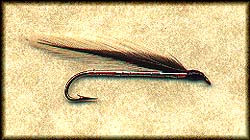
| HOOK | streamer |
| BODY | flat silver tinsel |
| WING | badger hackle |
Simple Dace 2
Submitted by Doug Saball

| HOOK | streamer |
| TAIL | red hackle barbules |
| BODY | silver braided mylar tubing |
| WING | badger hackle |
Simple Dace 3
Submitted by Doug Saball

| HOOK | streamer |
| BODY | flat silver tinsel |
| THROAT | red hackle barbules |
| WING | badger hackle |
See also The Marabou Thunder Creek BND by Chris DelPlato and The Male Dace by Bob Petti.
- Log in to post comments

looks good - want to
looks good - want to try it.