
Mark Dysinger has been chasing smallmouth bass with the flyrod for many years, and during that time he's come across some surprisingly difficult fish. Super clear water and high fishing pressure can make these bass as fussy and easily spooked as any educated trout.

Weapons for jumping |

Bert smiles |
I've been chasing
smallmouth bass with the flyrod for many years, and during that time I've come across some surprisingly difficult fish. Super clear water and high fishing pressure can make these bass as fussy and easily spooked as any educated trout. In these conditions, usual patterns and presentations are either ignored or send the fish fleeing to the haven of deeper water.
It was after
several sessions of frustration on the water that I began to take a well-established routine and adapt it for use on picky smallmouth bass in clear shallow water. Once I became confident with the method in its new application, I began to catch more shallow fish, even in waters that had been host to the heavy pressures of bass tournaments on the same day.
The jumping nymph
technique has been around for many years. Described in Gary Borger's great volume Nymphing, it's used in clear water conditions for spooky, easily agitated fish. The most common scenarios are western mountain lakes and eastern spring creeks, were trout are as cautious as they come. In a nutshell, casting far ahead of a target fish's cruising path severely reduces the chances of the fish getting spooked by the presentation. The fly settles to the bottom, and when the fish in question is close enough to see the presentation, the fly lifts (or "jumps"). Strikes are most commonly out of reflex. I took the challenge with the picky bass and turned it into an opportunity to expand upon the use of the jumping nymph. If it works for skittish trout, then it only seemed natural to me that it could be put to use in another shallow water situation.
Gearing Up
Equipment for the
jumping nymph technique really isn't any different than that which is normally used for smallmouth bass. Here's a rundown of what I generally use.
Rod:
The main consideration for this technique is rod length. A long rod provides excellent line control, and allows for more reach with a vertical presentation. I typically use an 8½ or 9´ 7 weight rod with a relatively fast action to help with getting casts off and ahead of moving fish.
Lines:
Presentations are made well ahead of moving fish, so delicate tapers aren't necessary. I find that weight-forward lines make casting to target spots quick and easy. Floaters are good for very shallow water, and intermediates are effective for slightly deeper waters. The clear lines (intermediate or ghost tip) that have come to market in the last several years are perfect for this type of fishing because they offer the angler another element of stealth.
Leaders:
Fluorocarbon leader material is a great asset because it has a higher sink rate and a lower refractive index than mono. It's the best option for a stealthy presentation.
Glasses:
Being able to see smallmouth in the shallows requires a good pair of polarized lenses. Which shade to wear depends upon the prevailing light conditions. For very bright days with few clouds, dark grey is an excellent choice. For overcast days with less ambient light, amber or very pale yellow lenses fit the bill nicely.
Sounds easy enough
, right? Well, there are a few prerequisites for this technique to be effective. First, this is ultimately sight fishing. Water clarity and light penetration can be limiting factors, so a good pair of polarized glasses is a must, and a cap with a brim helps too. Second, since the water is typically shallow, your presence as an angler must go undetected. If this isn't possible, then your presence should be as unobtrusive as possible. Dress in neutral colors, keep a low profile, and use any available cover to mask movement. If fishing from a boat, eliminate excess noise that could be transmitted through the water column by achieving propulsion via drift, electric motor, or oars. Once these factors are taken into account, the method can really start to prove its worth. To keep in spirit with the method, I will continue to call it the jumping nymph technique; however, since I will be describing a system that can be used for bass, the fly may not necessarily be a nymph. With that in mind, I'll start by describing general fly presentation.

Releasing |
The most common
presentation is more or less horizontal, i.e. the fish are far enough away that you make a cast and retrieve the fly back to your position. Smallmouth bass in shallow water are nearly always active and on the move searching for food. After spotting a fish or group of fish, try to time the cruising speed and path for the best possible cast. Depending upon water depth, water clarity, and the speed of fish to be intercepted, this could mean casting anywhere from ten to thirty feet ahead of the moving targets in anticipation of their movement. When a fish is within a reasonable distance of the fly (usually a foot or two), gently lift it off of the bottom with a smooth strip.

Orange Scorpio |

Black Scorpio |

Green Scorpio |
It's important not to yank the fly off the bottom in a haphazard fashion. Remember, you're trying to entice your quarry, not alarm it. If the fish is going to strike, it will most likely do so at this point. Since takes tend to be instinctive, they are usually fast and a simple smooth hook set will suffice. If the fish does not bite on the initial jump, try to tap its reflexes by making each additional jump slightly farther and faster. If the fish still doesn't take, wait until it completely loses interest and turns before lifting your line from the water and starting another cast. Beginning a back cast or roll cast while the fly is still in front of a disinterested fish will either further discourage it or spook it.
Sometimes the initial
jump of the fly off of the bottom will alarm the fish. When this happens, learn from the experience. You now know that the bass are very spooky, and that future presentations will require jumping the fly perhaps a bit earlier and more subtly. As time passes, the bass may start to become a bit more aggressive, and the initial jump will have to go back to being more deliberate. Let the fish and their reactions to the fly dictate which presentation you use. I usually try to use a more subtle approach on my initial presentation; if I don't draw a reaction and am fortunate enough to have a second shot at the same bass, I pick up the intensity of the next presentation in hopes of getting some attention. I find this to be better than a very aggressive initial presentation that has the potential of spooking a smallmouth, leaving little or no opportunity for a second chance.
While the horizontal
presentation of the jumping nymph is by far the most common application, there are a few circumstances where the presentation will become nearly vertical. When angling from a boat, fish will sometimes follow the fly to almost directly underneath the craft. And when angling from shore or wading, some fish will follow and then nestle up tight to the bank or relatively close to you. In these situations, keep the fly near or on the bottom and then manipulate it nearly straight up and down. It's imperative to be as inconspicuous as possible with this method because you are simply much closer to the fish than in the horizontal method. Instead of casting it out and away, work the fly off of the bottom with very little (if any) fly line. In some cases, just leader, tippet, and fly need to be beyond the rod tip. The same general technique applies here, with the necessity of added subtlety. To avoid rod movement, manipulate the fly by stripping it up and down with the line hand. Again, don't take the fly from the water while it's still close to a fish that's apparently lost interest. Ripping the fly from the water at such a point will only serve to put that fish on alert, and when one becomes spooked it has the potential to spook others.

White Swiper |

Olive Swiper |
The environment of
the smallmouth bass, particularly in relatively shallow water, is quite conducive to the jumping nymph method. Gravel bars, reefs, rocks, bays, and edges of weedbeds in lakes and rivers are prime spots to apply it. Since we are talking about sight fishing in shallow water (up to about six feet deep), the time of year is an important factor in determining just how practical this technique will be. I have had success from spring through fall, with most of it coming during the fall. Since smallmouth tend to spend a majority of their summer daylight hours in deeper water, early and late in the day will find more fish cruising in the thinner waters during that season. But when autumn arrives, bass start to feed more aggressively in anticipation of the approaching winter. When water temperatures start to cool, smallmouth frequent relatively shallow water for very prolonged periods of time throughout the day. The shallows of lakes and rivers have an ecological diversity of food items that is tough for bass to pass up, particularly at this time of year.

Olive Swiper |

Swiper head |
When you find
a piece of water that has a good number of bass coming through, it's often best to just set up and let the fish continue to come by. By posting up in one spot you can avoid spooking most fish before even making your presentation. Scrambling from one spot to another can be wasteful when the greenest pasture is right in front of you. Some key areas that are likely to get high fish traffic are the edges of reefs and gravel flats that are adjacent to deeper water. Another is any river or stream inlet, no matter how insignificant it may seem. These areas are usually accessible to the wading angler. If you fish from a boat, you can hit the previously mentioned spots plus what may be one of the most overlooked opportunities on a body of water: underwater humps and bars hidden far from shore.
Fishing on bright
days affords the best possible sighting of bass in the water. However, during the summer months, fewer bass will tend to be roaming the shallows during the prime sighting window. Fishing on overcast summer days means that more bass will be roaming the shallows, but they will be harder to spot because of the obvious decrease in available light. Given a choice between the two summer options, I would opt for the overcast day and fish armed with amber or pale yellow lenses and the confidence that more smallmouth will be available in the spots I am searching.
New techniques are
constantly evolving to improve success with catching difficult fish, but we should never be too quick to ignore an older technique that has proven itself in certain situations. The innovative use of an older method can be just the answer to a flyfishing problem. While this technique may not have been developed with bass in mind, it is certainly effective in the right conditions. The next time the smallmouth are shallow and uncooperative, try to get a jump on them with your fly. Let the fish dictate the nature of your retrieve, and you might be surprised with the results.
Flies to Jump
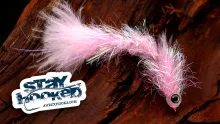
For the jumping nymph technique, I exclusively use fly patterns that have the hook point riding in the up position. This has the obvious advantage of preventing snags. There are many patterns out there that fit the bill nicely for this type of work, but over time I have come up with a few wrinkles to existing patterns that seem to do the job very well. I prefer materials that will move and give the impression of life with very little movement. Zonker strips, marabou, and round rubber are some pattern components that achieve this. When bass are particularly wary and picky, smaller sizes seem to perform better. As for color, natural muted colors seem to outperform attractor colors.

Three Scorpio's |
Olive Swiper |
- Log in to post comments




Good article Mark I
Good article Mark I love the simple approch you use to catch smallies,I use the kiss (keep it simple stupid) approch to fish for small mouth and never failed to give me hours of fun,Try using a rubber leg cone head wolly bugger (#8-12) in olive or black works for me.