German fly angler Florian Baumann had heard about peacock bass in the Amazon, but there was more fishing in Brazil than he thought
Idea and plans
I had the idea of one more long-distance flyfishing trip.
Having fished in Cuba, Mexico and Florida, I felt I needed perhaps some new ideas.
I went to the German fly show EWF in Fürstenfeld-Bruck in 2025 and checked booths and presentations. There was a nice guy talking about Brazil and flyfishing. I don’t know about others, but Brazil was flyfishing terra incognita for me.
I had heard about peacock bass in the Amazon, but learned during Eduardo’s presentation that there is more to Brazil than I thought.
The Northeast has tarpon and other saltwater species. He also offered an enticing trip on the Amazon fishing for Peacock Bass. The trip I found most interesting was a combination of peacock bass and golden dorado in the Brazilian state Mato Grosso.
Gear and fly recommendations
As one would expect, information for gear and flies was supplied.
For the peacock bass take a 7 weight with a floating line, an 8 or 9 weight with an intermediate (the bread and butter rod as it turned out) and a sinking/sinktip.
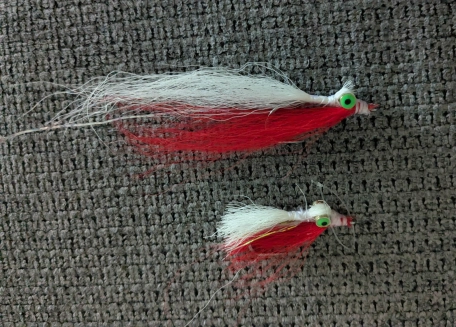
Flies for peacock: clouser deep minnows, chartreuse/white, red/white, fire tiger, baitfish patterns. The recommended leader was a fluorocarbon with a 20-30 lbs. tippet.
For Golden Dorado in the river use the 8 or 9 weight with the lines used for Peacock. Flies: Andino Deceiver, normal Deceiver, larger baitfish flies. Leader for the Golden Dorado, 50 lbs FC as minimum, preferably no wire tippet. Bring a 5 or 6 weight with a floating line for a fish that was new to me, Piraputanga. They eat rather large terrestials, i.e. hoppers and cicadas on size 4 and 1 hooks. This dry fly fishing called for a 10 lbs tippet also fluorocarbon.
Then the usual stuff, hot weather gear, sun protection, stripping guards etc.
Travel
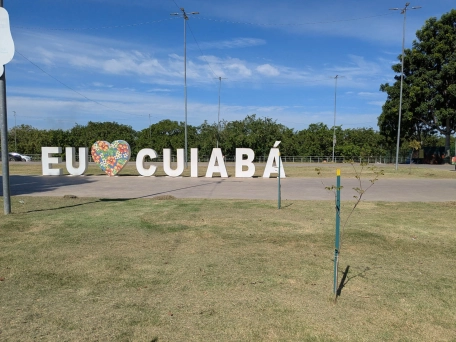
The adventure started at Cuiabá. This is the regional center of the Mato Grosso state. Checking the flights, it became clear that this was going to be a long journey. I ended up flying from Hamburg via Lisbon and Belo Horizonte to Cuiabà. The journey was a 29-hour deal, including the drive from home to the airport.
Arriving at 1:10 in the morning I had some concerns about transport to the hotel, not the least because of safety. It turned out to be a breeze. I arrived, luggage was there 😊 and got an Uber. That was the first time in my life I used their services.
All went well; I ended up in a nice hotel and slept like a baby.
A break
The next day I rested in Cuiabá. This is not the most touristy place on earth. I had heard the aquarium was a place to visit. The Uber stunt worked well again and to my surprise there was no entrance fee. The fish on display were from Brazil's fresh water, and the aquarium was well kept and worth the visit.
Returning from this little trip I met Eduardo, my host and fishing partner for the week. We went to a fish restaurant for lunch. A big variety of mostly freshwater fish was on offer. So I had Pacu, catfish stew, fish ribs and bacalao (salted dried cod, a Brazil/Portugal/Spanish delicacy). Fish ribs were new to me, the belly part of e.g. a catfish are flour dusted, fried and eaten from the bones like spareribs. We left stuffed and I was impressed with the variety.
Evenings we walked around town, ended in an open “beer garden”, had a light lunch and a couple of the local beers.
We had a relaxing morning and a light lunch.
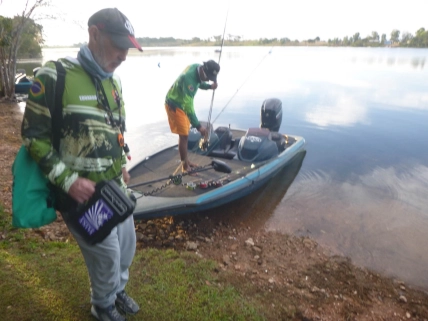
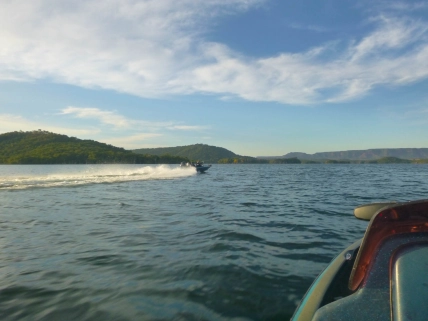
On the lake
Early afternoon we were picked up for a transfer to the first lodge located on the Manso Dam, a reservoir covering 427 km².
The lodge is modern and a good base for fishing. The habitual check into the fly boxes by the locals yielded a nod, which is always a good feeling. The staff of the lodge is very supportive, the bar tender gets you whatever you desire, the chef does a brilliant job and especially the head guide Joao aka as Neto is an enthusiastic man. He radiates a lot of positive energy.
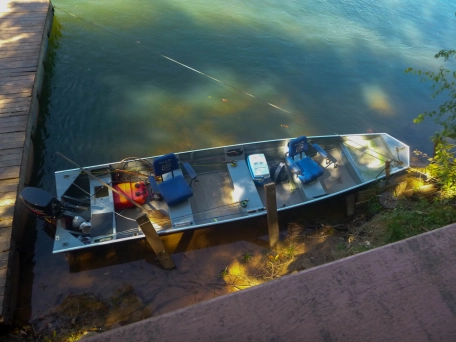
The size of the water requires some serious boats. The lodge operates bass boats with a 100 HP outboard. The boatmen know only one position for the throttle: full speed ahead.
Breakfast at 6:00. Brush teeth and then start the adventure. First spot 7 weight floating and a clouser minnow, after a couple of casts the first peacock bass ate it. Not a huge one, but the skunk is out of the boat.
The lake is crystal clear; the plants in the water are beautiful. In some parts the old trees are standing in a light gray, a marvelous picture.
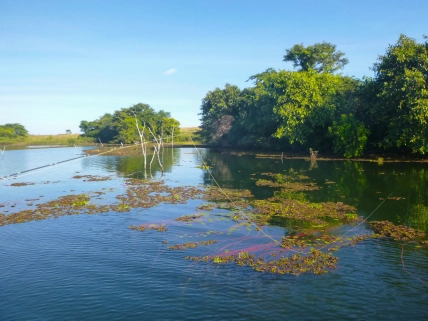
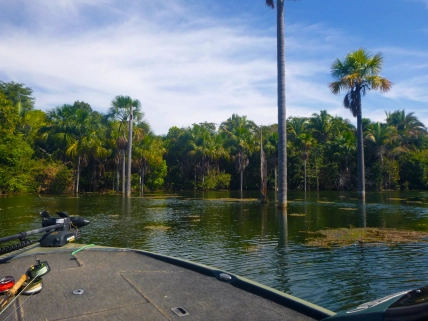
Shallow bays
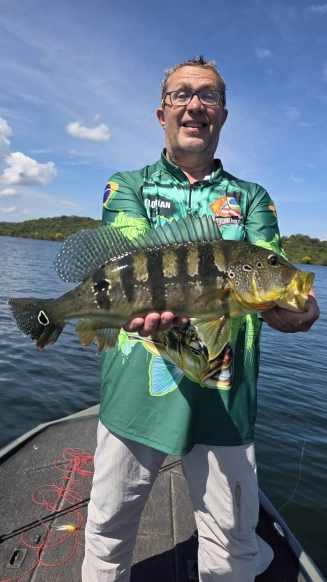
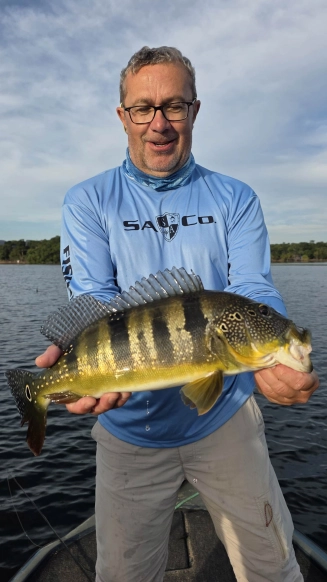
The fishing was mostly in shallow bays around the dead trees under lily pads and around vegetation in the water. I could see fish following the fly and refusing to eat, but there were plenty of takes. Some violent.
I had a fairly big fish T-boning my fly from the weeds that almost ripped the rod out of my hands, but didn’t get hooked. On the morning of the second day, Jefferson, the lodge manager, took the helm and we sailed for almost an hour to a more remote part of the lake which receives less pressure.
Two retrieves worked well: really slow and steady and, recommended by the lodge manager, strip fast and stop. Takes often came at the stop.
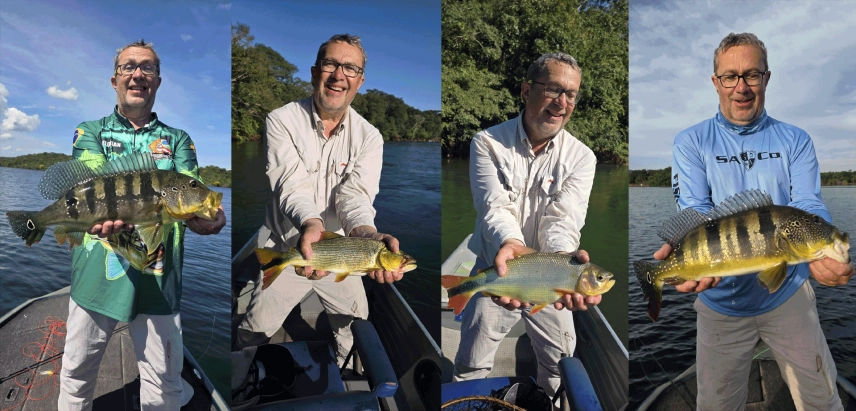
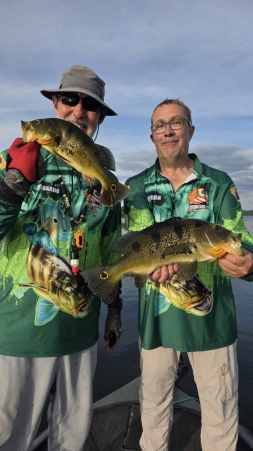
There are 15 species of peacock bass, and the lake holds three of them: Piquiti, Kelberi, Pinima. These are not the Acu from the Amazon; they range from modest 30-35 centimeters to fish in the fifties.
The biggest fish in the boat was 59 cm.
But make no mistake. They fight above their weight class. My tummy was bruised from putting the fighting butt against it. On the best day we had 48 fish in the boat between two rods. There was also a slow afternoon when the bass didn't want to play and the Piranhas more so.
Piranhas are a nuisance
Fly attrition ... the Piranhas are a nuisance. Even if you just have a take, your fly may look as if you cut it with a sharp tying scissor. Revenge was taken, we kept 7 of them and they ended up as a truly delicious ceviche.
When one of us had a peacock on, the fellow fisherman kept the fly close to the fighting fish. They are curious and it's often possible to double up.
When fishing a deep bank, I had a take from a fish that I couldn’t hold. The boatman and Eduardo thought this may have been a Tambaqui. They grow very big and the 22 lbs tippet simply wasn't enough.
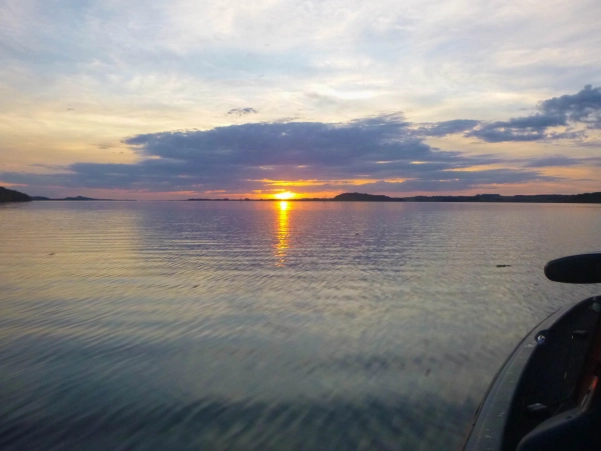
The magical ending of the lake fishing was at a submerged island at last light. That is the sleeping place of the peacock bass in the lake, and we caught fish fairly deep.
Change to the river
After returning to the lodge, we packed our stuff and transferred to the second lodge located on the Manso River, a tributary to the Cuiabá River. The river has riffles and slower stretches and holds Golden Dorado and Piraputanga.
This lodge is more rustic and has its own charm. There was still plenty of room. A bar with a competent bartender, mixing tasty Caipirinhas.
The lodge caters mainly to Brazilian fishermen and -women. The most common technique is live bait followed by baitcasting. We were the only ones flyfishing on the river.
My flyboxes passed the check by the locals, and I received a few “fishy flies” for both species from the lodge owner.
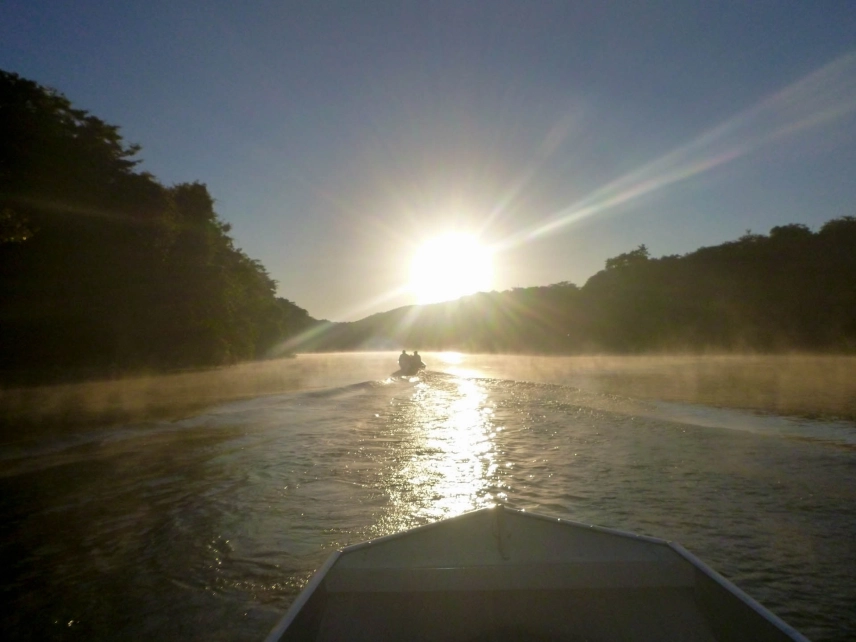
Breakfast at 6:00, by 6:30 we were in the boat. This was a different deal than on the lake. Same length but slimmer with a 30 hp outboard. These boats were obviously less stable than the bass boats on the lake. So I stayed low and sat partly down when other boats passed.
Fishing from a drifting boat
That was my first time fishing from a drifting boat, and it took a moment to sort myself. Depending on the bank we were fishing backhand casts were required as the boatman didn’t appreciate a size 3/0 hook crossing over his head. I also needed to take the drift into consideration when casting. After a while I settled into the rhythm.
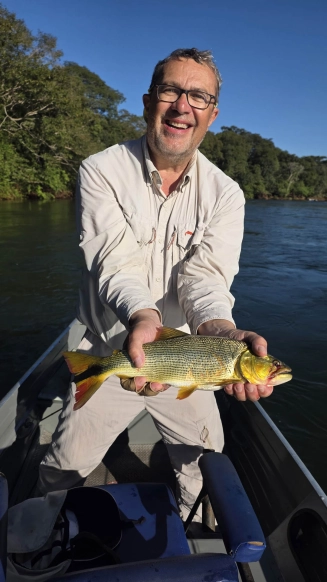
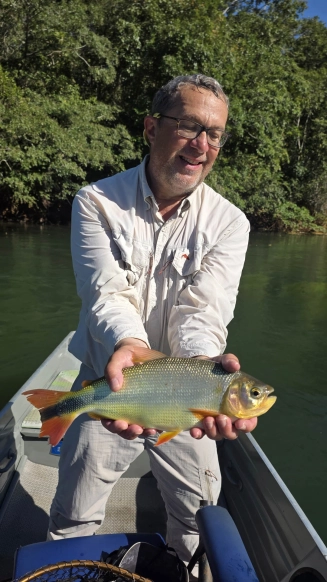
The Dorado fishing was slow both days, even when we fished before breakfast on the second morning, but there were still the Piraputangas, nicknamed South American trout. They feed on insects, small fish and crustaceans. We used foam hoppers and cicadas on hook sizes 1 to 4. They take fast, and hookset is sometimes a little tricky. They fight well over their size including air acrobatics. During the morning fishing I hooked a fish of about 1 kg. It put a nice bend in the 5 weight.
In the course of the days we hooked and landed quite a few of them. One fly was lost to their teeth.
Way home
After 5 intense days of fishing it was time to get my sorry self home. Transport to the airport was early in the morning.
All connections worked well, luggage was there and produced within minutes after the landing, unusual for Hamburg.
Getting home from the airport was the most difficult part of the journey home. There was a European Iron Man competition in town, and the usual jam at the tunnel under the Elbe got me driving across town.
In the end
Was it worth it? Absolutely!
The fisheries are little known, at least in Europe.
They offer an interesting alternative to the trodden path and I found exploring them rewarding. Not the least meeting nice people and learning more about Brazilian culture and cuisine.
- Log in to post comments