
Double Legs is a great looking fly and an easy tie with no intricate steps or materials.

Double Legs is a Swedish fly pattern originated by Erik Andreasson, and its construction and appearance draws traces back to many well known Scandinavian patterns such as Ullsocken, The Omoe Brush and many others featuring double or triple hackles, again having the Irish shrimp flies as their ancestors.
While trying to trace the origins and history of the fly, which I saw first on Facebook tied by Swedish Daniel Smith (the post has unfortunately disappeared), I found a few references to Erik Andreasson, and on the site Invicta Flies I saw it titled as a Dalby Dribbler variant.
Now, the Dalby Dribbler
is a fly that I know! That fly is tied by my good friend Mark Vagn Hansen, and was featured here on GFF many, many years ago. Reading that reference, I could clearly see the similarities. The colors and materials are different, but the construction and profile is very much the same. The Double Legs has the addition of a bead, and while the Dalby Dribbler is a saltwater fly imitating a small bug or shrimp, the Double Legs is much more a caddis larva or emerger.
The bright green color
is very common in the non-cased caddises, and even the egg laying adults will often feature this green colored tag. So the Double Legs pattern can imitate several stages of these very common insects.

I would not hesitate
fishing it in the salt, but as Daniel Smith notes in his Swedish article on the pattern (unfortunately gone), the fly is an excellent stillwater fly and also very useful in streams where Daniel has pursued grayling with the fly - and with good luck.
The fly is an easy tie
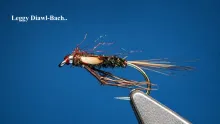
with no intricate steps or materials. There's some variation in the materials depending on who ties it. The original tied by Andreasson uses peacock herl for the body and black hackle and no bead head, while the alternative version tied by both Andreasson and David Smith, which is shown here, has a hare's mask body and partridge hackles as well as a bead for weight. I personally like both versions with a slight preference for the weighted version, but the variations just show that there's an opening for interpretations and possible adaptations to match the naturals in your waters and your fishing style. You can basically use what you have as long as you keep to natural colors and soft and not too long hackle feathers.
|
|
|
|
|
|
|
|
|
|
|
|


|
|
|
|
|
|
|
|
|
|
|
|
|
|
|


Fishing the fly
is much as you imagine. In stillwaters you can fish it on the bottom using a sinking line or leader and letting it go to the depths, slowly retrieving it with the figure of eight technique or simply move it by lifting the rod tip or pulling the line. In running water you can fish it on a floating line, cast upstream, mend and let the fly drift just under the surface, being extra alert when the current catches it or you start lifting it for the next cast, inducing that attractive and very emerger-like upwards motion in the water. Tying both a beaded and an unbeaded version will let you vary the depth of the fly in different current speeds.
Sources
The Dalby Dribbler
The Dalby Dribbler Variant, Double Legs Original
Beadhead Double Legs
Daniel Smith's article (in Swedish) - the site http://itsabouttrout.se/?p=2938 has unfortunately disappeared.

- Log in to post comments



Nice fly
Nice fly and very effective. I tie a similar variety of this excellent pattern which I think i got from a Pennsylvania website. It can be a killer with a copper head. A variation I use is tying the rear hackle with olive CDC whilst retaining partridge for the front hackle..
Nice pattern
Nice pattern, I can't wait to try it out on the White River closer to caddis time.
Hässäkkä
Here is another Finnish varied Kakshäkiläinen called Hässäkkä (~ mess) by Aarne Karjala http://perhorasia.fi/Fly/Fly.thtml?flyID=6771 The idea on Hässäkkä lies in the single flashabou tail flash and the weight which makes the fly swim upside down. It's a real killer, check it out yourself:
The page is in Finnish, but Google translator will prolly help.
Also used in East Europe
Martin, this fly is also used in East Europe for more than 20 years. I saw this pattern in an old fly fishing book from '80.
Here in my country (Romania) it's also known as Pulsar Fly. We use green, red or black floss, partridge feathers and glass beads for light flies or metallic beads for heavy flies. A few year ago we start to use jig hooks instead of classic hooks.
cheers
Lucian
Nice looking fly
Nice looking fly. I'm a warm water man and I'm thinking it will work well for panfish, particularly with that chartreuse flag on the tail. The variegated hackle looks very "buggy."
Kakshäkiläinen
This pattern resembles greatly a Finnish fly called Kakshäkiläinen tied by Lauri Syrjänen (deceased)