There are 17 species of leeches in the UK living in lakes and the slower stretches of rivers.
Worldwide there are 480 freshwater species of the little suckers.
They feed on small fish, amphibians and invertebrates, and get eaten by bigger fish. They are common in the lakes and rivers that I fish in Wales. Many of our mountain lakes have a lot of them, which can be a bit disconcerting to people going for a swim to cool off in the heat.
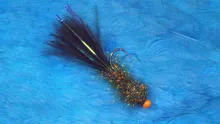
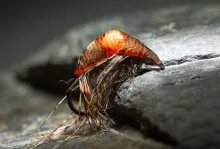
Latex Leech
Nick Thomas
The Latex Leech has a flexible detached latex body tied over hollow monofilament braid fly line backing threaded onto a needle held in the vice.
Wrapping over braid allows the body to slide off the needle when completed, wrapping nymph skin directly onto the needle will just result in the body sticking. The braid also provides a strong core to the body for attaching to the hook.
Materials and process
Nick Thomas
Latex Leech
Nick Thomas
Latex Leech
Fly pattern, materials and tying steps
Nick Thomas
Materials
Hook
Fasna F-425 #12
Bead
Get Slotted 2.5-4mm copper tungsten
Thread
12/0 tan
Body
Translucent nymph skin over hollow monofilament braid
Fix a needle in the vice and slide on a length of hollow braid leaving a few cm of braid off the point of the needle.
Run on the thread just back from the point and wind down to 1cm from the end of the braid and back up.
Catch in the end of a length of nymph skin and tie down along the top of the braid. Secure the thread with a whip finish and wind back up the needle.
Apply a thin coat of superglue to the nymph skin on top of the braid and then wind the latex strip forward in overlapping turns varying the tension to create a body of varying thickness.
Tie in the nymph skin, fold the end back and whip finish on to the braid. Slide the completed detached body off the needle.
Trim the braid to at the back end of the body, melt near a lighter flame and push against the lighter to squash the end against the body.
Place the bead onto the hook, run on the thread and lock the bead in place.
Tie in the detached body by the braid with the whip finish sitting over the bend. Tie down the braid up to the bead and trim off the end.
Wind the free end of nymph skin from the detached body around the hook and then forward in overlapping turns.
Tie in behind the bead, stretch the end and trim and whip finish.
Colour the body with marker pens.
Medium
I tie my leeches for both rivers and lakes. The river versions have a tungsten bead, typically 2.5 or 3mm for casting with a fly line for fishing slower water, or 4mm for euronymphing deeper water with a nymphing or tenkara rod.
For lakes I tie them without a bead, adding a wrap of lead foil to the hook before attaching the body.
The Global FlyFisher has been online since the mid-90's and has been free to access for everybody since day one – and will stay free for as long as I run it.
But that doesn't mean that it's free to run.
It costs money to drive a large site like this. See more details about what you can do to help in this blog post.